
Minimalist Jewelry Alternatives to Gold Plated
Table of Contents
- Why Gold-Plated Jewelry Fades and What You Can Wear Instead
- Gold-Plated vs Gold-Filled Jewelry: Which Lasts Longer
- Gold Vermeil Jewelry: A Mid-Range Option for Everyday Wear
- Stainless Steel Gold-Tone Jewelry: Affordable and Durable
- Titanium Jewelry for Sensitive Skin: A Hypoallergenic Choice
- Silver-Tone Alternatives: Timeless Minimalist Options
- How to Choose the Right Alternative and Care for Your Investment
- Frequently Asked Questions
Last Updated: October 16, 2026
Why Gold-Plated Jewelry Fades and What You Can Wear Instead
Gold-plated jewelry offers the warm glow of gold without the solid gold price tag, but durability is the problem.
This is where minimalist jewelry alternatives to gold plated come in. Several other materials deliver the clean lines, lightweight feel, and versatile style you want without the short lifespan of gold plating.
At JazzySuSu, we curate jewelry designed to be worn repeatedly and loved for years, and we want you to understand which materials hold up to everyday wear.
The core issue is thickness and adhesion. Plating is applied in microns, and once that layer wears away, it can't be restored without replating. Water, chlorine, sweat, and skin oils accelerate the process, while minimalist jewelry alternatives to gold plated offer genuine durability without the maintenance headaches.
Gold-Plated vs Gold-Filled Jewelry: Which Lasts Longer
Gold-filled jewelry is fundamentally different from gold plating. Gold-filled means a layer of solid gold is mechanically bonded to a base metal core, typically brass or copper, and the gold layer is much thicker than plating, usually at least 5% of the total weight of the piece.
Because of that substantial gold content, gold-filled jewelry resists tarnishing and fading far better than gold-plated alternatives. Many gold-filled pieces last 10-20 years with normal wear, compared to months or a few years for gold plating.
The trade-off is price. Gold-filled costs more than gold-plated but significantly less than solid gold, making it a middle ground for anyone seeking minimalist jewelry alternatives to gold plated that still deliver authentic gold appearance.
Gold Vermeil Jewelry: A Mid-Range Option for Everyday Wear
Gold vermeil is gold plating applied to sterling silver, not brass or copper, a difference that matters in how the piece ages and looks when the gold layer eventually wears.
Vermeil requires a minimum gold thickness of 2.5 microns by federal standard, thicker than standard gold plating.
For minimalist jewelry alternatives to gold plated, vermeil offers genuine appeal: pieces feel substantial because of the silver base, cost less than gold-filled or solid gold, and age gracefully rather than looking worn out.
The catch is that vermeil still requires care. Harsh chemicals, chlorine, and prolonged moisture can damage both the gold layer and the silver underneath, so it's not a "wear it anywhere, anytime" option like stainless steel or titanium.
Stainless Steel Gold-Tone Jewelry: Affordable and Durable
Stainless steel gold-tone jewelry takes a completely different approach. Instead of a thin gold layer, manufacturers use stainless steel alloys that naturally have a warm, gold-like color, so there's no plating to wear away.
Stainless steel resists tarnishing, doesn't corrode easily, and holds its finish through years of daily wear. Gold-tone pieces won't fade to a dull silver or expose a base metal because the color comes from the alloy itself, so you can wear them in the shower, at the pool, or during exercise.
The aesthetic is the trade-off.
Stainless steel is also hypoallergenic for most people. Many alloys contain nickel, but high-quality stainless steel (304 or 316 grade) uses nickel in a form that doesn't trigger reactions for most people.
Titanium Jewelry for Sensitive Skin: A Hypoallergenic Choice
If you have a nickel allergy or reactive skin, titanium is one of the most reliable metals you can wear. It is naturally nickel-free, extremely lightweight, and essentially immune to tarnish and corrosion.
Why titanium works for sensitive skin. The metal contains no nickel and forms a stable oxide layer that resists reaction with sweat and skin oils.
The gold-tone question. Titanium's natural color is a cool silver-gray. Gold-tone titanium gets its color from a surface coating, usually PVD (physical vapor deposition), not from the metal.
Grades and practical specs. Jewelry-grade titanium is usually commercially pure (Grade 1 or Grade 2) or Ti-6Al-4V (Grade 5).
The Best Of Hoops Earrings, Matte Silver →
Where titanium falls short. It is harder to solder and finish than silver or steel, so minimalist designs tend to be simpler, and it cannot be easily resized.
For minimalist jewelry alternatives to gold plated, titanium is the strongest choice when sensitive skin and zero-maintenance durability matter more than gold color.
Silver-Tone Alternatives: Timeless Minimalist Options
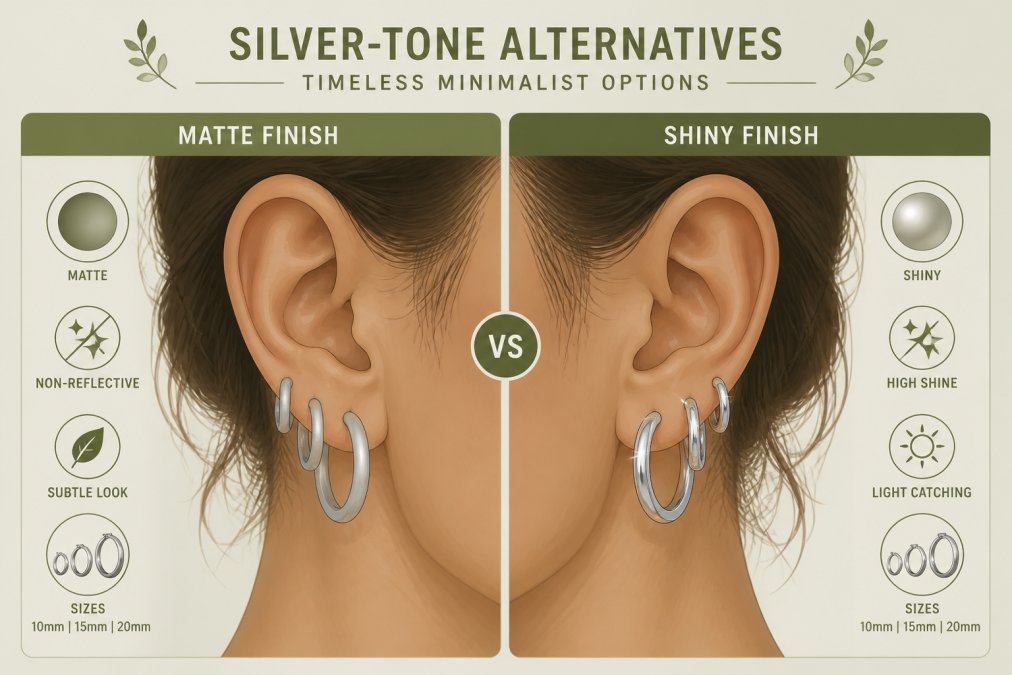
Sterling silver and silver-tone jewelry represent the classic minimalist choice.
Silver-tone alternatives include rhodium-plated silver, which resists oxidation far better than silver alone. JazzySuSu's Upper Class Taste Hoop Earrings in both Small and Big Silver feature a matte silver finish that works beautifully with minimalist styling.

For minimalist jewelry alternatives to gold plated, silver-tone offers genuine timelessness. Silver works with every color, season, and style, making it the foundation of a capsule jewelry collection.
Sterling silver tarnishes with exposure to air and moisture, but tarnish is easy to remove with a soft cloth or silver polish. Rhodium-plated pieces require less maintenance but still benefit from occasional polishing.
How to Choose the Right Alternative and Care for Your Investment
Choosing the right minimalist jewelry alternative comes down to four practical questions: how your skin reacts, how you actually wear your jewelry, how much care you will realistically do, and what the piece costs per wear over time.
A true side-by-side comparison
The table below puts construction, durability, appearance, water resistance, skin sensitivity, and typical U.S. price range side by side so you can compare like for like.
| Material | Construction | Typical durability | Appearance | Water resistance | Skin sensitivity | Typical U.S. price range |
|---|---|---|---|---|---|---|
| Gold-plated | Thin gold layer (often under 1 micron) electroplated over brass or copper | 6-12 months of regular wear | Warm gold, can look bright initially | Remove before water | Base metal may contain nickel | $10-$40 |
| Gold-filled | Thick gold layer (at least 5% of total weight) mechanically bonded to brass or copper core | 10-20 years with care | Warm gold, close to solid gold | Occasional moisture only | Depends on core; often nickel-free | $30-$120 |
| Gold vermeil | Gold plating of at least 2.5 microns over sterling silver | 2-5 years of regular wear | Warm gold over silver | Remove before water | Sterling silver base; generally low reactivity | $40-$150 |
| Stainless steel (gold-tone) | Alloy with gold-tone color, or PVD coating over 304/316L steel | 10+ years | Cooler gold tone, reads as gold-colored | Yes, including shower and pool | 316L is low-reactivity for most | $15-$60 |
| Titanium | Nickel-free metal, natural silver-gray; gold tone via PVD | Indefinite | Silver-gray; gold tone is cooler | Yes | Excellent for sensitive skin | $20-$80 |
| Sterling silver | 92.5% silver with copper or other alloys | 10+ years with polishing | Cool silver, develops patina | Limited; remove before swimming | Generally safe; some react to alloys | $20-$100 |
Gold-plating thickness and terminology, explained
Marketing language makes materials sound closer than they are. In the U.S., "gold vermeil" must have a gold layer at least 2.5 microns thick over sterling silver. Standard gold plating has no minimum and is often well under 1 micron, which is why it wears through in months. "Gold-filled" requires a gold layer at least 5% of total weight, mechanically bonded rather than electroplated. "Gold-tone," "gold finish," and "gold color" are surface treatments with no thickness guarantee. Vermeil and gold-filled have measurable standards you can ask a brand about; generic gold plating does not.
Care instructions by material, with realistic water limits
Tarnish resistance is not the same as water resistance. Use these material-specific rules:
- Gold-plated: Remove before showering, swimming, or exercising. Keep away from lotions, perfume, and hair products. Store dry in a pouch. Expect 6-12 months of regular wear before visible wear.
- Gold-filled: Wipe with a soft cloth after wear. Occasional moisture is fine, but remove before swimming, especially in chlorinated or salt water. Store dry. With care, 10-20 years is realistic.
- Gold vermeil: Remove before swimming, showering, and heavy sweating. Chlorine and salt water can damage both the gold layer and the sterling silver underneath. Polish gently with a silver cloth.
- Stainless steel: Shower, pool, and gym-safe in most cases. Rinse and dry after salt water exposure to prevent surface spots. No polishing required.
- Titanium: Effectively maintenance-free. Wipe with a soft cloth. PVD gold-tone coatings should be treated gently to avoid deep scratches.
- Sterling silver: Store in an anti-tarnish bag or airtight container. Polish with a silver cloth as patina develops. Remove before swimming to slow tarnish.
Lifecycle cost and replacement frequency
A lower sticker price is not always the cheaper choice. The table below shows a cost-per-wear comparison using typical U.S. prices and realistic wear lifespans, assuming daily wear.
| Material | Typical price | Realistic wear life | Cost per wear (daily wear) |
|---|---|---|---|
| Gold-plated | $25 | 9 months | About $0.09 |
| Gold-filled | $70 | 12 years | About $0.02 |
| Gold vermeil | $90 | 3 years | About $0.08 |
| Stainless steel | $35 | 10 years | About $0.01 |
| Titanium | $45 | 10+ years | Under $0.01 |
| Sterling silver | $50 | 10 years | About $0.01 |
Gold-plated jewelry can look cheaper per wear on paper, but the comparison changes once you account for replacement. A $25 gold-plated piece replaced every nine months costs about $100 over three years, while a $70 gold-filled piece worn for the same period costs $70 and keeps going. For minimalist pieces you plan to wear daily, the higher upfront price is usually the better long-term value.
A quick decision framework
- Sensitive skin or nickel allergy: Titanium first, then 316L stainless steel, then nickel-free gold-filled or vermeil over sterling silver.
- Swim, shower, or exercise in your jewelry: Stainless steel or titanium.
- Want a warm gold tone with real longevity: Gold-filled, then vermeil if you prefer a silver base.
- Want the lowest cost per wear: Titanium or stainless steel.
- Want a classic silver look: Sterling silver, accepting occasional polishing.
JazzySuSu offers several silver-tone options that exemplify the durability and style you want. The Best Of Hoops Earrings in Matte Silver ($10.00) delivers minimalist appeal at an accessible price point, while the Brilliant Silver version ($11.25) features rhodium plating that resists tarnishing longer.
If you prefer lightweight tube-style hoops, the Upper Class Taste collection offers two sizes. The Small Silver ($15.00) at 1.5 inches is perfect for everyday wear and layering. The Big Silver ($16.25) makes a subtle statement while maintaining minimalist sensibility. All pieces are lead-compliant and designed for repeated wear without losing their finish or appeal.

The real investment in minimalist jewelry isn't just the initial purchase price. It's about choosing materials that align with your actual lifestyle and wearing them enough to justify that choice.
Frequently Asked Questions
What is the best alternative to gold-plated jewelry?
Gold-filled jewelry and gold vermeil offer the best durability for everyday wear. Gold-filled pieces contain 100 times more gold than gold plating and resist tarnishing for years. Gold vermeil sits between gold plating and gold-filled in terms of cost and longevity. For budget-conscious shoppers, stainless steel gold-tone jewelry provides a tarnish-free option that maintains its appearance with minimal care, making it ideal for minimalist pieces you wear repeatedly.
What jewelry material looks like gold but lasts longer?
Gold-filled jewelry and gold vermeil both deliver the warm gold appearance without the fading. Gold-filled maintains its color for 5-30 years depending on wear, while gold vermeil lasts 2-5 years with proper care. Stainless steel gold-tone jewelry won't fade at all and resists water and tarnishing indefinitely, though the color may be slightly cooler than traditional gold. Choose based on your budget and how long you want your pieces to last.
Is gold-filled jewelry better than gold plated?
Yes. Gold-filled jewelry contains a solid layer of gold bonded to a base metal core, making it 100 times thicker than gold plating. While gold-plated jewelry typically lasts 6 months to 2 years before fading, gold-filled pieces endure 5-30 years of everyday wear. Gold-filled costs more upfront but offers significantly better value over time, especially for minimalist staples like hoops and delicate chains you wear constantly.
Which jewelry materials are best for sensitive skin?
Titanium and surgical stainless steel are hypoallergenic and ideal for sensitive skin or nickel allergies. Titanium is completely nickel-free and won't cause irritation even with prolonged wear. Stainless steel marked as lead and nickel compliant is also safe for sensitive ears. Gold vermeil and gold-filled can work if the base metal is nickel-free, but titanium remains the safest choice. Always check product descriptions for lead and nickel compliance before purchasing.