
Vintage Aesthetic Clothing for Everyday Wear
Table of Contents
- What Defines the Vintage Aesthetic in Clothing
- Vintage Aesthetic Outfit Ideas for Beginners
- Building a Capsule Wardrobe with a Vintage Aesthetic
- How to Style Vintage Clothes for Work
- Accessorizing Your Vintage Aesthetic Outfit
- Budget-Friendly Sourcing and Sustainable Thrifting
- Fabric Care and Garment Preservation
- Conclusion
Last Updated: August 10, 2026
What Defines the Vintage Aesthetic in Clothing
Vintage aesthetic clothing is a style approach that draws on the silhouettes, fabrics, and design details of past decades to create outfits that feel nostalgic, intentional, and timeless. It isn't about wearing museum pieces. It's about channeling the worn-in sensibility, romantic aesthetic, and careful tailoring of earlier eras and making them work for your actual life.
At JazzySuSu, we've spent years curating pieces that capture this feeling without requiring a trip to a specialty archive or a fashion history degree. The result is a wardrobe that feels genuinely personal rather than trend-chasing.
The core of the vintage aesthetic is authenticity. Where fast fashion prioritizes speed and disposability, vintage-inspired dressing prioritizes character. A well-chosen piece should look like it has a story. That means paying attention to details: the weight of a fabric, the curve of a collar, the way a skirt moves. These elements are what separate a thoughtfully assembled vintage-inspired outfit from a costume.
What most guides miss is that the vintage aesthetic isn't one single look. It's a family of related sensibilities that each pull from different fashion history periods.
Key Decades Worth Drawing From
Each decade offers its own vocabulary of shapes, textiles, and attitude. Understanding which era resonates with you is the fastest way to build a coherent wardrobe.
- 1930s-1940s: Bias-cut silhouettes, wide-leg trousers, structured shoulders. A romantic aesthetic with serious tailoring underneath.
- 1950s: Full skirts, fitted bodices, polished accessories. The original capsule wardrobe era.
- 1960s: Geometric patterns, mod shifts, bold color blocking. Clean lines with a playful edge.
- 1970s: Flare jeans, bohemian influence, earthy tones, and floral embroidery. The decade most associated with the free-spirited vintage revival happening now.
- 1980s-1990s: Oversized blazers, high-waist cuts, lace-up corsets, and grunge-era layering. Retro-inspired looks from these decades are particularly accessible through thrifting right now.
You don't need to commit to a single decade. Many of the most compelling vintage aesthetic outfits mix references across eras, pairing a 1970s silhouette with 1950s accessories, for example.
Vintage Aesthetic Outfit Ideas for Beginners
Starting with vintage aesthetic clothing doesn't require a complete wardrobe overhaul. The most effective approach is to build around two or three anchor pieces that establish the aesthetic, then fill in with simpler basics.
A young woman wearing a flowy floral midi dress with lace-up boots and a wide-brim hat captures the look immediately. That combination alone hits the key notes: a timeless silhouette, a romantic textile, and accessories with real character. Everything else in the outfit can be plain.
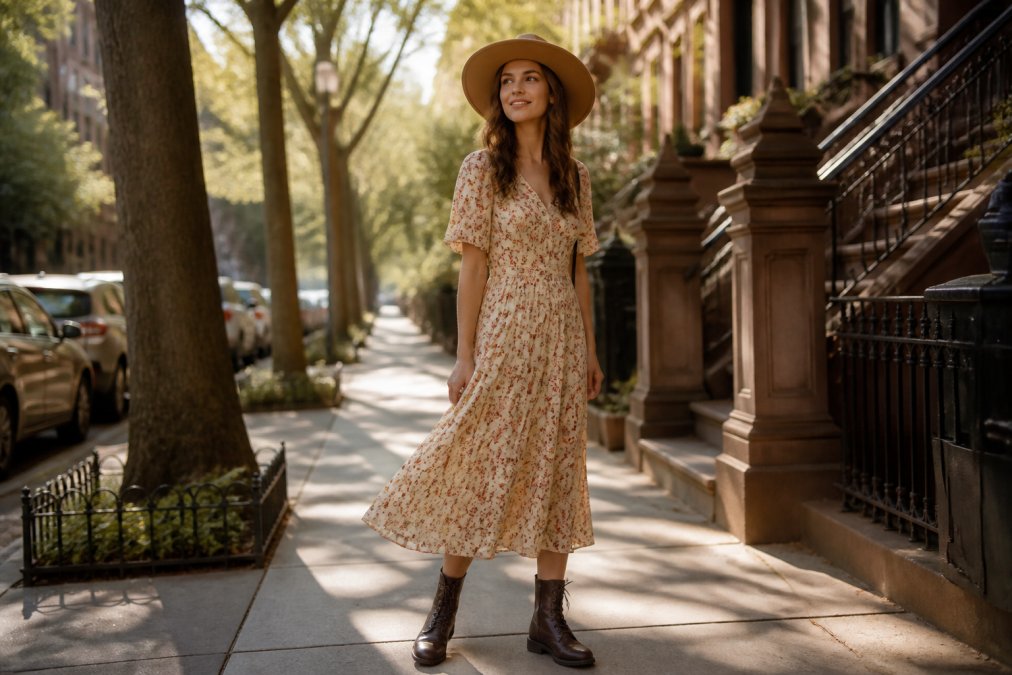
The biggest mistake beginners make is trying to do too much at once. One statement piece per outfit is the rule. Build from there.
Wardrobe Staples to Start With
These are the wardrobe essentials that appear across nearly every vintage-inspired look. Start with whichever three feel most natural to your existing style.
- A midi or maxi dress with floral or geometric patterns - The single easiest entry point. Pairs with almost anything.
- High-waist trousers or flare jeans - Classic cuts that immediately read as retro-inspired without requiring much else.
- A lace or crochet top - Adds texture and the bohemian influence that defines much of the current vintage revival.
- An oversized blazer or tailored jacket - The piece that makes the whole look wearable as everyday wear rather than costume.
- A wrap dress or skirt - A timeless silhouette that flatters consistently and transitions across seasons.
- A simple white or cream blouse with interesting collar detail - Jabot shirts and Victorian-inspired necklines are having a significant moment right now.
Styling Tips by Body Type
The vintage aesthetic works across every body type, but the decade you pull from makes a real difference. This is the part most styling guides skip entirely.
- Hourglass figures: 1950s silhouettes were designed for you. Full skirts with fitted bodices and wrap dresses emphasize your natural shape.
- Pear-shaped figures: 1970s wide-leg trousers and flare jeans balance proportions beautifully. Pair with a fitted top to keep the look intentional.
- Apple-shaped figures: Empire waists and A-line cuts from the 1960s create length and flow without restriction. Shift dresses are a strong choice.
- Petite figures: Avoid overwhelming volume. Mini lengths from the 1960s, or midi dresses with a defined waist, keep the look proportional.
- Tall figures: You have the most flexibility. 1940s wide-leg trousers and 1970s maxi dresses look particularly strong on taller frames.
Building a Capsule Wardrobe with a Vintage Aesthetic
A capsule wardrobe built around the vintage aesthetic typically includes 12-15 pieces that mix and match across most occasions. The goal is a curated collection where every item earns its place.
According to the Ellen MacArthur Foundation's research on fashion and sustainability, the average garment is worn only seven times before being discarded. A capsule wardrobe approach directly counters this by prioritizing pieces designed to be worn repeatedly.
The capsule wardrobe vintage aesthetic framework breaks down into three tiers:
| Tier | Pieces | Function |
|---|---|---|
| Foundation (5-6 pieces) | High-waist trousers, wrap dress, tailored blazer, simple blouse, flare jeans | Everyday wear backbone |
| Statement (4-5 pieces) | Floral midi dress, embroidered top, lace layer, printed skirt | Outfit focal points |
| Transitional (3-4 pieces) | Cardigan, slip dress, wide-leg jumpsuit | Bridges seasons and occasions |
The foundation tier should be in neutral or muted tones. The statement tier is where pattern, texture, and embellishment earn their place. The transitional tier handles layering, which is essential to making vintage-inspired pieces work year-round.
Mixing Vintage with Contemporary Pieces
This is where the vintage aesthetic becomes genuinely wearable for everyday life rather than reserved for special occasions.
The rule is simple: anchor the look with one authentic vintage or vintage-inspired piece, then build the rest of the outfit with modern basics. A 1970s-style embroidered blouse works with straight-leg contemporary jeans. A vintage-inspired floral skirt pairs cleanly with a plain fitted t-shirt. The contrast is the point. Reimagined classics land harder when they're not competing with too many other statement pieces.
Layering is the technique that makes this work in practice. A slip dress over a plain long-sleeve. A tailored blazer over a floral midi. An oversized cardigan over a lace-up corset top. Each combination creates something that reads as intentional rather than assembled.
How to Style Vintage Clothes for Work
Knowing how to style vintage clothes for work is where many people get stuck. The concern is reasonable: vintage-inspired fashion can tip into theatrical quickly, and most workplaces require some degree of restraint.
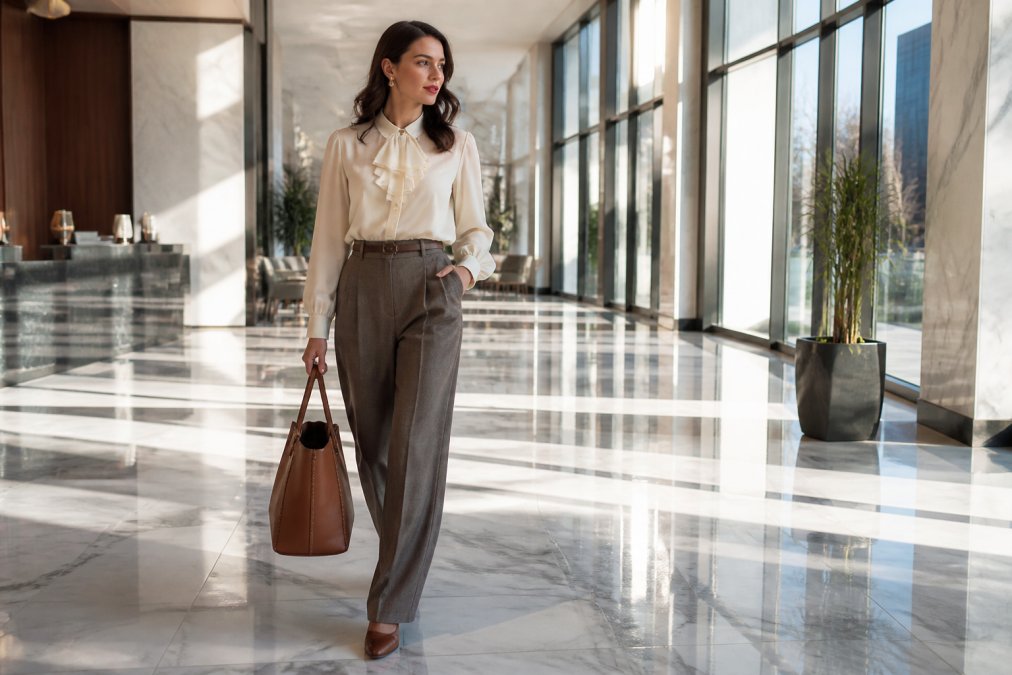
The answer is tailoring. Structured, well-fitted pieces from any era translate to professional environments. A 1940s-inspired wide-leg trouser in a solid color with a simple blouse reads as polished, not costume. Geometric patterns in muted tones work in most offices. Jabot shirts, which are experiencing a significant revival, add vintage character without sacrificing professionalism.
Here's a practical framework for workplace vintage styling:
- Keep silhouettes clean. Avoid anything with heavy embellishment or multiple competing details.
- Prioritize fit above all else. A vintage-inspired piece that fits precisely looks intentional. The same piece in the wrong size looks like a thrift store find.
- Use accessories to signal the era. A structured vintage-inspired bag or a pair of classic pumps does more for a vintage work look than a bold garment.
- Test one new piece at a time. Introduce vintage elements gradually rather than committing to a full look immediately.
- Stick to classic cuts in professional fabrics. Wool crepe, silk, and structured cotton in vintage silhouettes are the safest entry points.
For creative industries, the range expands considerably. Lace-up corsets layered over blouses, floral embroidery on structured jackets, and vintage-inspired statement pieces all work in environments where personal expression is expected.
Accessorizing Your Vintage Aesthetic Outfit
Accessories are where the vintage aesthetic either comes together or falls apart. The right ones elevate a simple outfit into something that feels genuinely curated. The wrong ones tip the look into costume territory.
A few principles that hold across every era:
- One statement accessory per outfit. A wide-brim hat, a vintage-inspired brooch, or a bold pair of earrings. Not all three.
- Bags should have structure. Soft, unstructured bags undercut the intentionality of a vintage look. Structured totes, boxy clutches, and crossbody bags with hardware read as era-appropriate.
- Shoes are often the deciding factor. Lace-up boots, block-heeled mules, Mary Janes, and pointed-toe flats all carry strong vintage signals without requiring much else from the outfit.
- Jewelry should feel handpicked. Layered chains, pearl details, cameo brooches, and floral embroidery-inspired pieces all work. The key is that each piece looks chosen, not grabbed.
JazzySuSu's handpicked jewelry collection is specifically designed for this kind of layering, with pieces that carry enough character to anchor an outfit without overwhelming it.
Budget-Friendly Sourcing and Sustainable Thrifting
Sustainable fashion and the vintage aesthetic are natural partners. Buying secondhand, thrifting, and choosing pieces designed to last all reduce the environmental impact of your wardrobe, and they're also the most direct routes to authentic vintage finds.
According to the Environmental Protection Agency's textile waste data, Americans discard millions of tons of clothing annually, the vast majority of which ends up in landfills. Thrifting and secondhand shopping directly counter this cycle.
Practical sourcing strategies that actually work:
- Start with estate sales and charity shops in higher-income zip codes. The quality of donations correlates strongly with neighborhood demographics.
- Visit thrift stores mid-week. Restocking typically happens over the weekend, and mid-week visits catch the best new arrivals before the weekend crowd.
- Search online secondhand platforms by fabric type, not just style. Searching "silk blouse" or "wool trousers" rather than "vintage blouse" surfaces higher-quality pieces.
- Build relationships with local consignment shops. Many will notify regular customers when pieces matching their preferences come in.
- Check vintage-inspired retailers for new pieces designed with the same sensibility. Not every piece in a vintage-aesthetic wardrobe needs to be secondhand. New pieces made with classic cuts and quality fabrics fill gaps that thrifting can't always cover.
The question of quality is one we hear often: will this actually last, or is it fast fashion with a vintage filter? The honest answer is that it depends entirely on the fabric and construction. Natural fibers, French seams, and reinforced closures are the signs of a piece built to last years rather than seasons.
Fabric Care and Garment Preservation
Garment preservation is the part of the vintage aesthetic that most guides skip. It's also the part that determines whether your pieces last two years or twenty.
As documented in the Smithsonian Institution's textile care guidelines, natural fibers like wool, silk, cotton, and linen require specific care approaches that differ significantly from synthetic fabrics. Getting this right extends garment life considerably.
The fundamentals of textile care for vintage and vintage-inspired pieces:
- Wash less frequently. Most garments don't need washing after every wear. Air them out between uses.
- Hand wash or use a delicate cycle in cold water. Heat is the primary cause of fiber breakdown and color fading.
- Store knits folded, not hung. Hanging stretches the shoulders and distorts the shape over time.
- Use cedar blocks rather than mothballs. Cedar is effective and doesn't leave chemical odors in the fabric.
- Steam rather than iron when possible. Direct heat from an iron can damage delicate fabrics and flatten embroidery.
- Store in breathable garment bags. Plastic traps moisture; cotton or linen storage bags allow fabrics to breathe.
For pieces with floral embroidery, lace, or other delicate details, turn the garment inside out before washing and place it in a mesh laundry bag. This protects the surface details from abrasion.
The worn-in sensibility that makes vintage clothing appealing is a product of careful use over time. Pieces that are washed roughly and stored carelessly lose that quality fast. Pieces that are treated with intention develop it.
Building a wardrobe around vintage aesthetic clothing is one of the most sustainable and personal approaches to getting dressed. The challenge is finding pieces with genuine character rather than fast-fashion approximations. JazzySuSu's curated collection of vintage-inspired fashion and handpicked jewelry is built specifically for this purpose, with pieces selected to be worn repeatedly and to develop meaning over time. Free shipping on orders over $100 makes it easier to build your collection without compromise. Shop now and find the pieces that will define your signature look.
Frequently Asked Questions
How do I start a vintage aesthetic wardrobe?
Start with three or four versatile staples: a high-waist flare jean, a floral or embroidered blouse, a tailored midi skirt, and one statement outerwear piece. Thrift stores, curated online shops, and estate sales are reliable sources. Build slowly around a consistent color palette so pieces mix and match easily. Prioritize natural fabrics like cotton and linen, which hold up better over time and carry that worn-in sensibility that defines authentic vintage style.
What is the difference between true vintage and vintage-inspired clothing?
True vintage refers to garments made at least 20 years ago, often with construction details and fabric weights that modern manufacturing rarely replicates. Vintage-inspired clothing uses classic cuts, retro patterns, and nostalgic silhouettes but is produced today with current sizing standards and quality controls. For everyday wear, vintage-inspired pieces from curated collections offer the aesthetic without the fragility or fit challenges that come with decades-old garments.
How can I mix vintage clothing with modern pieces?
Anchor one vintage statement piece per outfit and keep everything else contemporary. A 1970s-style flare jean pairs cleanly with a simple fitted white tee and modern sneakers. A lace-up corset layered over a plain slip dress reads romantic without feeling costume-like. The goal is contrast: one retro-inspired element against clean, modern basics. Accessories like geometric earrings or a structured bag can bridge the two eras without overwhelming the look.
Where can I find affordable vintage aesthetic clothing?
Thrift stores, consignment shops, and online resale platforms are the most budget-friendly options for authentic vintage pieces. For vintage-inspired clothing with consistent sizing and quality, curated boutiques and small online shops offer edited selections that save you hours of searching. Check for free shipping thresholds before ordering multiple pieces at once, since bundling items often brings the total cost per piece down significantly.
This article was written using GrandRanker