
How to Choose Retro Bridal Accessories for Your Wedding
Table of Contents
- Start with Your Dress: How to Choose Retro Bridal Accessories That Match Your Silhouette
- The Essential Trio: Veils, Jewelry, and Belts for a Retro Bridal Look
- How to Style Retro Wedding Jewelry: Mixing Eras and Modern Elements
- Buy Unique Handmade Statement Jewelry: Sourcing Authentic Vintage Pieces
- Restoration and Care: Keeping Your Retro Bridal Accessories Timeless
- Trends and Timelessness: What's New in Retro Bridal Accessories for 2026
- Conclusion: Your Curated Bridal Ensemble
- Frequently Asked Questions
Last Updated: September 22, 2026
Start with Your Dress: How to Choose Retro Bridal Accessories That Match Your Silhouette
The dress comes first. Every retro bridal accessory decision flows from your gown's shape, fabric, and neckline.
Here's the rule: match the accessory weight to the dress weight. A heavy beaded gown needs bold pieces. A simple silk slip dress needs delicate ones.
A common mistake is buying a statement necklace for a gown with heavy embellishment. The eye has nowhere to rest.
Neckline Matters: Pairing Accessories with Your Gown
Your neckline decides where jewelry goes, and where it doesn't.
- Sweetheart or strapless: Statement earrings, skip the necklace
- V-neck: A pendant or short drop necklace works well
- High or illusion neckline: Earrings and a hairpiece only
- Off-shoulder: A delicate collar or nothing at all
The goal is balance. If the neckline draws the eye, let the jewelry support it instead of competing.
Balancing Focal Points: Statement Pieces vs. Minimal Details
Pick one focal point. That's the whole game.
If your veil has heavy lace, keep jewelry minimal. If your earrings are the statement, skip the tiara. A cohesive bridal look comes from restraint, not stacking.
The Essential Trio: Veils, Jewelry, and Belts for a Retro Bridal Look
Veils, jewelry, and belts do the heavy lifting in any retro bridal ensemble. Get these three right and the rest falls into place.
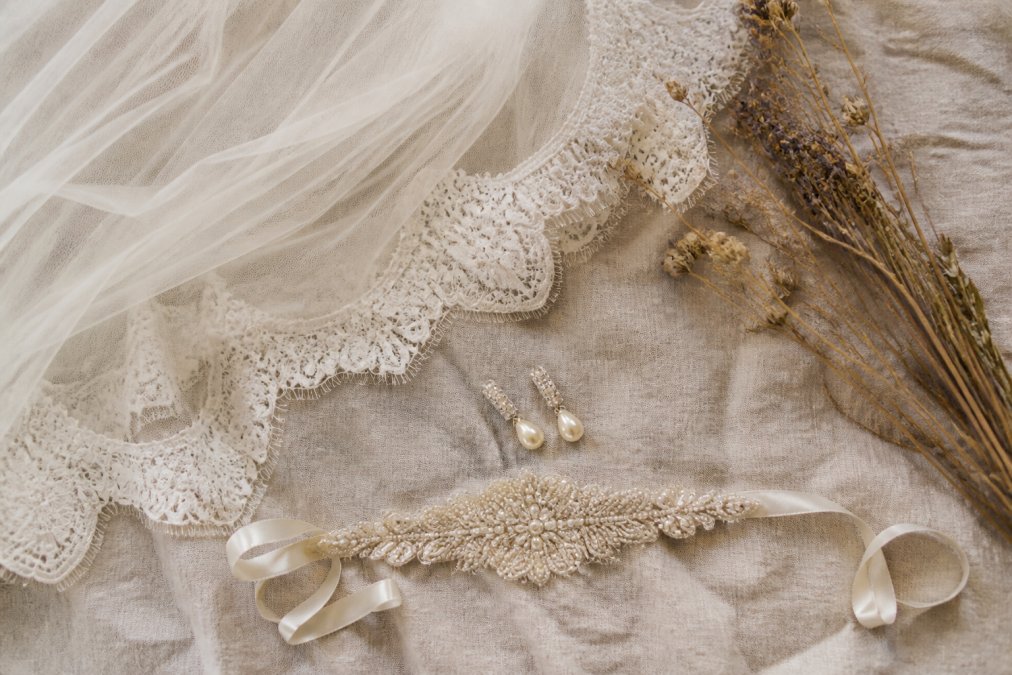
Veil Lengths and Styles: Cathedral, Birdcage, and More
Veil length changes the whole silhouette.
- Birdcage: Vintage 1920s feel, sits above the chin
- Fingertip: Safe, classic, works with most gowns
- Cathedral: Dramatic, needs a long train to justify it
- Mantilla: Spanish lace, best for structured gowns
For retro looks, birdcage and mantilla styles carry the most era-specific charm.
Jewelry: From Pearl Drops to Statement Rhinestones
Pearl drops suit Art Deco and Victorian themes. Rhinestone tassels lean mid-century glam.
Our Gemological Institute of America guide to pearl types explains how freshwater and akoya pearls differ, which helps when you're verifying vintage pieces.
For brides who want sparkle without weight, the Luxury Pearl Drop Earrings from our collection use cubic zirconia and rhodium plating at just 8g per pair.

Belts and Sashes: Defining Your Waist with Vintage Flair
A sash or waist belt adds proportion to a column or A-line gown. Choose ribbon for softness, beaded belts for drama. Art Deco belts often use geometric metalwork. Mid-century styles favor simple satin sashes with a brooch at center.
How to Style Retro Wedding Jewelry: Mixing Eras and Modern Elements
Mixing eras works when one era leads and the others follow. Pick a dominant decade, then add one modern piece as contrast. The modern piece keeps the look from reading as costume.
- Art Deco lead: Geometric earrings, a modern plain band
- Mid-century lead: Pearl studs, a sleek modern veil
- Victorian lead: Cameo brooch, simple modern shoes
Styling by Decade: A Working Framework
Most guides stop at naming the era. The useful part is knowing which accessories each decade actually produced, what silhouettes they were built for, and where they break down on a modern gown.
Elegant Crystal Drop Earrings for →
The One-Era Rule
If you're styling around an heirloom, let it lead. Build everything else to complement it. A common pattern is that brides who try to combine two strong eras end up with a look that photographs as neither. Pick the decade that matches your gown's silhouette first, then layer in one modern piece, a plain band, a simple shoe, an unadorned veil, to anchor it in the present.
Buy Unique Handmade Statement Jewelry: Sourcing Authentic Vintage Pieces
Sourcing real vintage takes patience. Sourcing vintage-inspired takes judgment. Both can work beautifully, but they are not the same purchase, and the price, care, and resale value differ sharply.
Genuine Vintage vs. Vintage-Inspired: What the Labels Mean
The trade generally uses three terms, and sellers apply them loosely:
- Vintage: Generally understood as at least 20 years old. A piece from the early 2000s can legitimately be called vintage.
- Antique: Commonly used for pieces 100 years or older. In jewelry, this usually means Edwardian, Art Deco, or earlier.
- Vintage-inspired (or vintage-style): A new piece made in an older design language. No age, no history, no resale premium, but also no fragility and no restoration risk.
Authenticity Verification: How to Spot Genuine Vintage
Check these before you buy:
- Clasp style: Older clasps predate modern spring rings. Look for box clasps, fish-hook clasps, and screw-backs on earrings. A screw-back earring is a strong signal of pre-1960s construction.
- Hallmarks: Look for maker's marks stamped into metal. In the U.S., precious-metal pieces are commonly stamped with a purity mark (for example, "14K" or "Sterling") and often a maker's mark. A clean, modern laser etch reads differently from a worn stamp.
- Patina: Real age shows uneven wear, not uniform shine. Replating erases patina, which is fine if disclosed, a problem if it isn't.
- Weight: Vintage pieces often feel heavier than modern copies because they were made with solid rather than hollow construction.
- Findings and solder: Look at the back of the piece. Hand-soldered joints and slightly irregular settings are typical of older work; perfectly uniform machine finishing usually signals a modern reproduction.
Ask sellers for close-up photos of the back, clasp, and any stamps. Reputable sellers provide them without hesitation. If a seller can't or won't, treat that as your answer.
Questions to Ask Before You Buy
A short script saves a lot of returns:
- What decade do you date this piece to, and what's that based on?
- Are there any repairs, replating, or replaced stones?
- What are the exact metal and stone contents?
- What's your return policy if the piece doesn't match the description?
Most vintage sellers price with condition in mind, so a piece with replaced stones should be priced below an all-original equivalent. If it isn't, ask why.
Sustainable Sourcing: Why It Matters for Your Wedding
A wedding generates a lot of one-time-use waste. Vintage and vintage-inspired accessories avoid that.
Restoration and Care: Keeping Your Retro Bridal Accessories Timeless
Vintage pieces need gentle handling. Modern vintage-inspired pieces need consistent care.
- Store earrings in a dry pouch, away from moisture
- Keep rhinestones away from perfume and hairspray
- Wipe metal with a soft dry cloth after wearing
- Never soak beaded or pearl pieces in water
Trends and Timelessness: What's New in Retro Bridal Accessories for 2026
Pearl-forward styling leads 2026 bridal looks. So do mixed-metal pieces and pearl-and-rhinestone combinations.
But trends fade. Timelessness comes from proportion and personality.
| Trend | Era Root | Best For |
|---|---|---|
| Pearl-forward styling | Victorian, Mid-Century | Classic brides |
| Mixed metals | Art Deco | Modern retro looks |
| Pearl + rhinestone | Mid-Century | Evening receptions |
| Birdcage veils | 1920s | Short gowns, city weddings |
| Statement tassels | Art Deco | Bold, maximalist brides |
Conclusion: Your Curated Bridal Ensemble
Choosing retro bridal accessories is really about editing. Start with the dress, pick one focal point, and let the essential trio do the rest.
Frequently Asked Questions
How do I match retro accessories to a modern wedding dress?
Focus on one or two vintage elements to avoid a costume look. If your dress is sleek and modern, add a birdcage veil or Art Deco earrings for a subtle retro touch. For a minimalist gown, a statement belt or vintage-inspired statement jewelry can be the focal point. Keep the rest of your accessories simple to let the retro pieces stand out. Balance is key: mix eras carefully, and consider the overall silhouette of your dress when choosing accessories.
What are the most iconic vintage bridal accessory styles?
Iconic styles include Art Deco-inspired pieces with geometric shapes and crystals, mid-century pearl sets, Victorian lace veils, and 1920s beaded sashes. Cathedral veils and birdcage veils are classic choices. Statement jewelry like rhinestone drop earrings or a tiara can evoke a specific era. Look for details like beading, lace, and filigree to capture the vintage aesthetic. These styles remain popular because they add timeless elegance and personality to a bridal look.
How can I incorporate heirloom jewelry into my bridal look?
Heirloom jewelry adds sentimental value and a unique story to your wedding day. If the piece is a necklace, consider wearing it as your main accessory and skip a statement necklace. For brooches, pin one to your bouquet or sash. Earrings can be paired with a simple veil. If the heirloom is too delicate, incorporate it into your bouquet wrap or sew it into your dress lining. This way, you honor family history while keeping your look cohesive.
Are vintage-inspired accessories appropriate for a formal wedding?
Yes, vintage-inspired accessories can be perfectly appropriate for a formal wedding, especially if they are elegant and well-crafted. Choose pieces with high-quality materials like crystal, pearl, or fine metals. A cathedral veil with lace or a pair of pearl drop earrings can enhance a formal gown. Avoid overly casual or kitschy items. The key is to match the formality of your dress and venue; a black-tie wedding calls for sophisticated vintage pieces, while a garden party allows for more playful retro touches.