
Bohemian Home Decor Styling Tips: A 2026 Guide
Table of Contents
- Bohemian Home Decor Styling Tips: Build a Cohesive Room in 6 Steps
- How to Mix Patterns in Home Decor Without Visual Clutter
- Choosing a Boho Color Palette: Earthy, Warm, and Vibrant Tones
- Boho Living Room Ideas: Layering Rugs, Throw Pillows, and Low Seating
- Eclectic Home Decor Ideas for Renters: No-Damage Ways to Personalize
- Room-by-Room Styling: Bedrooms, Dining Nooks, and Entryways
- Common Bohemian Decor Mistakes and How to Fix Them
- Conclusion: Your Bohemian Home Starts With One Layer
- Frequently Asked Questions
Last Updated: October 4, 2026
Bohemian Home Decor Styling Tips: Build a Cohesive Room in 6 Steps
Bohemian home decor is a free-spirited style built on layered textiles, warm color, natural materials, and objects you have collected over time. It rewards personality over perfection. This guide from JazzySuSu walks through six steps to pull a boho room together, from a neutral base to the final layer of personal treasures. You will also find fixes for the mistakes that make rooms feel cluttered instead of cozy.
The 6 steps we cover:
- Start with a neutral base
- Choose your color palette
- Layer texture and natural materials
- Mix patterns without clutter
- Add relaxed, low-profile furniture
- Finish with personal treasures
Most guides stop at inspiration photos. We start with the process.
What You'll Need Before You Start
Gather a few things before you move a single piece of furniture. A plan beats impulse buying every time.
- A neutral base: light wood, cream, or warm white walls and floors
- Two to three area rugs in different sizes
- Throw pillows and a throw blanket or two
- One or two woven or rattan pieces
- A live plant or dried branches
- A few collected objects: art, ceramics, travel finds
- A measuring tape and painter's tape
Renters should add removable hooks and adhesive strips to this list. We cover no-damage options further down.
How to Mix Patterns in Home Decor Without Visual Clutter
Most guides tell you to 'anchor patterns with a shared color' and stop there. That advice is true but incomplete, because clutter is not caused by too many patterns, it is caused by patterns that compete at the same visual weight. Fix the weight, and you can run more prints than you think.
The rule that does the real work is scale contrast. A pattern reads as calm when its repeat size is at least three times larger or smaller than the pattern next to it. A small-scale block print next to a large-scale ikat reads as intentional. Two medium-scale florals of similar size read as noise, even if the colors match perfectly.
Here is a working method:
- Pick a lead pattern. Choose one large-scale print, a suzani, a kilim, or an oversized botanical, and give it the biggest surface in the room, usually the rug or a single upholstered piece.
- Set the scale ratio. Every pattern you add after that should be roughly one-third the repeat size of the lead, or three times larger. Skip the middle. Middle-scale prints are what create the muddy look.
- Repeat color, not motif. Pull two or three colors from the lead pattern and let the smaller prints carry only those colors. The motifs can be completely unrelated, stripes, dots, geometrics, as long as the palette repeats.
- Insert one solid as a rest point. A solid textile gives the eye somewhere to land. Without it, even well-scaled patterns feel busy.
- Cap the count per sightline. Three patterns visible in a single view is the practical ceiling for most rooms. A fourth works only if it is a solid or a texture with no discernible repeat.
A few placement rules that prevent the most common failures:
- Keep the two boldest patterns apart. If the lead print is on the rug, do not put the second-boldest print directly on the sofa above it. Separate them with a solid or a texture.
- Match pattern density to surface size. Large repeats need large surfaces. A big medallion print on a small lumbar pillow gets cropped and reads as random.
- Let the floor and walls stay quiet. If the rug is the lead pattern, keep walls and large furniture in solids or subtle textures.
The most common mistake is buying every print you love in the same trip. The fix is not to remove a pattern, it is to change its scale. Swap one medium floral for a small geometric or a large stripe, and the whole arrangement settles.
Choosing a Boho Color Palette: Earthy, Warm, and Vibrant Tones
A boho color palette starts with a neutral base, then builds in earthy colors and warm tones, with one or two vibrant colors as accents. Think sand, clay, olive, rust, and mustard. Add a single jewel tone, such as deep teal or plum, if you want more energy.
How to build yours:
- Base layer: cream, oatmeal, or soft white
- Middle layer: terracotta, camel, sage, or olive
- Accent layer: rust, mustard, or a jewel tone
- Metal accents: brass, aged gold, or matte black
Keep the accent color to about a tenth of the room. One vibrant throw or a single piece of artwork is enough.
Boho Living Room Ideas: Layering Rugs, Throw Pillows, and Low Seating
The fastest way to a boho living room is layering. Start with a large area rug, then add a smaller one on top at an angle. Pile throw pillows in mixed sizes and textures on low seating, and let a throw blanket drape rather than fold.
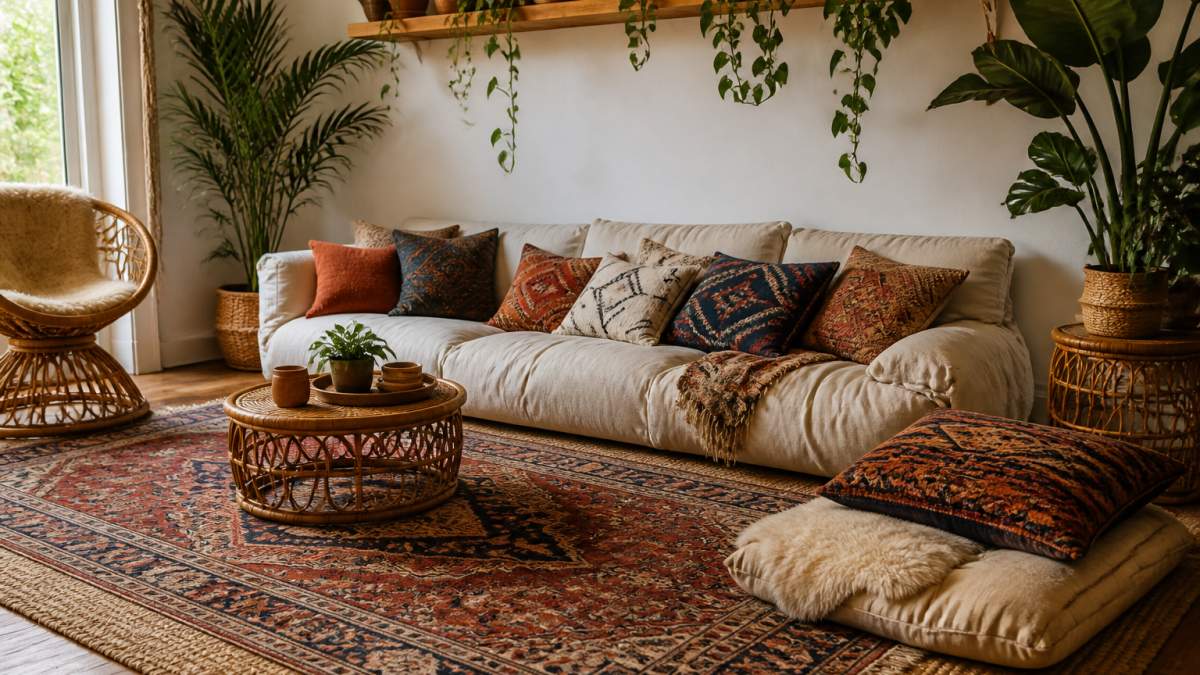
Low seating is the signature move. Floor cushions, pouffes, and a low sofa or lounge chair create the relaxed atmosphere that defines this style. Our Large Upholstered Lounge Chair with Ottoman and Armrests fits the look without the floor-level struggle. It has a rust-proof steel frame, a plush velvet cover, and a built-in side pocket for your phone, magazines, or remotes.
Large Upholstered Lounge Chair With Ottoman And Armrests →

Eclectic Home Decor Ideas for Renters: No-Damage Ways to Personalize
Renters can get the full eclectic look without losing a deposit. The key is leaning on pieces that stand, hang, or rest rather than screw into walls.
- Use removable adhesive hooks for lightweight art
- Lean framed prints on a shelf or mantel instead of hanging them
- Choose a freestanding bookshelf over built-ins
- Swap hardware with renter-friendly covers you can take with you
- Add a large leaning mirror for depth
Our Five Tier Industrial Bookshelf in Rustic Brown Timber is a good renter pick. It stands freely or sits flush against a wall, and holds up to 50 lbs per shelf.

Room-by-Room Styling: Bedrooms, Dining Nooks, and Entryways
Boho styling does not stop at the living room, and it does not require a large house.
Bedroom. Start with a low wood bed or a platform frame. A Chestnut Semi Circle Nightstand in solid mango wood brings a warm, curved shape that softens an all-angular room.

Dining nook. Use a small round table with mixed chairs. Add a woven pendant light and a linen runner. Keep the tabletop simple so the chairs carry the pattern.
Entryway. A bench, a basket for shoes, and a tray for keys. An Open Oak-ish Coffee Table with rounded edges works as a low entry bench or console in a narrow hall.
Kitchen. This is the room most boho guides skip, and it is the easiest to style because you are adding, not remodeling. Swap cabinet hardware for brass or matte black pulls.
Bathroom. Treat it like a small bedroom. A vintage or rattan stool holds folded towels. A woven basket corrals extra rolls.
Small spaces and studios. The constraint is circulation and storage, not style. Use these rules:
- Keep at least one 30-inch walking path through the room.
- Choose multifunctional pieces: an ottoman that stores blankets, a bench with a shelf underneath, a coffee table with a lower tier.
- Go vertical. A tall leaning shelf or a wall of floating shelves holds the collected-object look without eating floor space.
- Use one large rug instead of two small ones. Multiple small rugs chop up a small room and make it feel smaller.
- Limit each surface to three objects. On a small nightstand or console, three is the ceiling.
| Room | Anchor Piece | Texture Layer | Personal Touch |
|---|---|---|---|
| Bedroom | Low wood bed | Linen bedding | Framed photos, ceramics |
| Dining nook | Round pedestal table | Woven pendant | Handmade bowls |
| Entryway | Bench or low table | Baskets, flatweave rug | Leaning art, plant |
| Kitchen | Brass hardware | Woven pendant, kilim runner | Open-shelf ceramics |
| Bathroom | Rattan-framed mirror | Woven baskets, towels | Dried eucalyptus |
Common Bohemian Decor Mistakes and How to Fix Them
Most boho rooms fail for the same few reasons. Here is what goes wrong and how to correct it.
- Too many patterns. Fix: pull one print and add a solid.
- No neutral base. Fix: swap one busy textile for cream or light wood.
- All one texture. Fix: add rattan, linen, wool, or clay.
- Clutter, not collection. Fix: group objects in threes and leave empty space.
- New everything. Fix: mix in one vintage or handmade piece.
- Ignoring lighting. Fix: use varied lighting, such as a floor lamp, a table lamp, and candles.
Conclusion: Your Bohemian Home Starts With One Layer
Building a cohesive boho room takes patience, and the biggest hurdle is knowing where to start. We recommend beginning with a neutral base, then adding color, texture, and pattern one layer at a time. JazzySuSu offers a carefully curated collection of vintage-inspired home decor and handpicked pieces designed to be lived with for years, not a season. Enjoy free shipping on orders over $100, and let one good layer lead to the next. Shop now and start building a room that tells your story.
Frequently Asked Questions
What are common mistakes in boho decor?
The biggest mistake is treating bohemian home decor as a shopping list instead of a layered process. People buy ten patterned pillows at once and end up with visual noise. Start with a neutral base, add one texture at a time, and stop when the room feels collected rather than crowded. Another common error is skipping the anchor piece: without one large item like a rug or sofa, small accessories float with nothing to tie them together. Finally, avoid buying everything new. Boho style depends on personal treasures, travel finds, and handmade pieces that carry a story.
How do you mix patterns in boho decor without making a room feel busy?
Use the 3-5-7 rule as a starting point: one large-scale pattern, one medium, and one small, repeated across the room. Keep a shared color thread running through every print, and let a neutral base absorb the energy. For example, pair a large floral cushion with a medium geometric throw and a small dotted rug, all pulling from the same boho color palette. Give each pattern breathing room by separating busy textiles with solid textures like woven rattan, plain linen, or light wood surfaces.
How can you decorate a rental in a bohemian style without making permanent changes?
Renters can build a full eclectic home decor look with removable pieces. Use peel-and-stick wallpaper on one accent wall, lean a five-tier ladder bookshelf against the wall instead of mounting shelves, and layer area rugs over existing carpet to hide what you cannot change. Command hooks hold lightweight wall hangings, macrame, and string lights without damaging paint. Swap out cabinet knobs, add a floor cushion or pouffe for extra seating, and finish with a large upholstered lounge chair that moves with you when the lease ends.
What are the key elements of boho home decor?
Six elements do most of the work: a neutral base of light wood and soft whites, warm earthy colors with occasional vibrant accents, layered textiles like rugs and throw blankets, natural materials such as rattan and woven accents, greenery in baskets or hanging planters, and personal treasures that tell a story. Low seating, floor cushions, and varied lighting complete the relaxed atmosphere. You do not need all six in every room. Start with three, then add layers over time so the space reads as collected rather than decorated in one weekend.