
Does Vintage Clothing Run True to Size?
Table of Contents
- Does Vintage Clothing Run True to Size?
- Why Vintage Sizing Differs from Modern Sizing
- How to Measure Vintage Clothing
- Vintage vs. Modern Clothing Sizes
- Using a Vintage Clothing Size Chart
- How to Shop for Vintage Clothing Online
- Common Mistakes When Buying Vintage
- Frequently Asked Questions
Last Updated: October 15, 2026
Does Vintage Clothing Run True to Size?
The short answer is no. Vintage clothing rarely runs true to modern sizes, and that's one of the biggest surprises when you're shopping for pieces from earlier decades. We help customers navigate vintage-inspired fashion by understanding how sizing has shifted over time. A dress labeled "Medium" from the 1960s will almost certainly fit differently than a modern Medium. The cut, the fabric, the construction, and the actual measurements have all changed. This is where many buyers get frustrated, but it's also where a little knowledge makes all the difference.
The real issue isn't that vintage sizing is wrong, it's that sizing standards themselves have changed dramatically. Vanity sizing became standard in the 1980s and has only accelerated since then. Manufacturers began making garments larger while keeping the same size label to make customers feel good. A size 10 today is genuinely bigger than a size 10 from 1975. Add in regional differences, brand-specific quirks, and the fact that older clothing was often custom-tailored or made with less standardization, and you quickly see why a vintage piece needs its own evaluation.
The good news? You can absolutely find vintage clothing that fits perfectly. You just need to measure.
Why Vintage Sizing Differs from Modern Sizing
Vintage sizing differs from modern sizing for several concrete reasons. Understanding these differences helps you make smarter purchases and avoid costly mistakes.
Vanity sizing is the biggest culprit. Starting in the 1980s, manufacturers began cutting garments larger while keeping the same size label. This made customers feel slimmer and boosted sales. A modern size 8 is often cut the same as a vintage size 12.
Historical tailoring standards also matter. Vintage clothing, especially from the 1950s and earlier, was often made with more generous ease, extra room built into the garment for comfort and movement. Modern fast fashion prioritizes a closer fit.
Standardization didn't exist in earlier decades the way it does now. Before the 1960s, size standards varied wildly between manufacturers. One brand's size 10 bore no relationship to another's. Even after standardization efforts, many smaller manufacturers and vintage pieces ignored the standards entirely.
Fabric and construction changed too. Vintage garments often used natural fibers like cotton and wool with minimal stretch. Modern clothing frequently uses synthetics and blends with elasticity built in. A stretchy fabric can fit a wider range of body types. A rigid vintage fabric cannot.
International sizing adds another layer. Vintage European or British clothing uses different size systems than American vintage. A British size 12 is not the same as an American size 12, and vintage pieces from different countries follow their own historical standards.
How to Measure Vintage Clothing
Measuring vintage clothing properly requires two separate processes: taking your own body measurements and measuring the garment itself. Both are essential.
Taking Your Body Measurements
Start by measuring yourself accurately. You'll need a soft measuring tape, a mirror, and ideally a second person to help, though you can manage alone.
Bust measurement: Measure around the fullest part of your chest, keeping the tape snug but not tight. Wear a bra you plan to wear with the garment. Round to the nearest half-inch.
Waist measurement: Find your natural waist, the narrowest part of your torso, usually about an inch above your belly button. Measure comfortably, not pulling the tape tight.
Hip measurement: Measure around the fullest part of your hips and bottom. Keep the tape parallel to the ground.
Shoulder width: Measure from the outer edge of one shoulder bone to the outer edge of the other. This is harder to do alone but crucial for dresses and tops.
Sleeve length: Measure from the center back of your neck, across your shoulder, down your arm to your wrist. Bend your arm slightly for comfort.
Length: For dresses, measure from your shoulder bone down to where you want the hem to hit, usually the knee or mid-thigh for modern wear.
Write these numbers down. You'll use them to evaluate every vintage piece you consider.
Measuring Garments Laid Flat
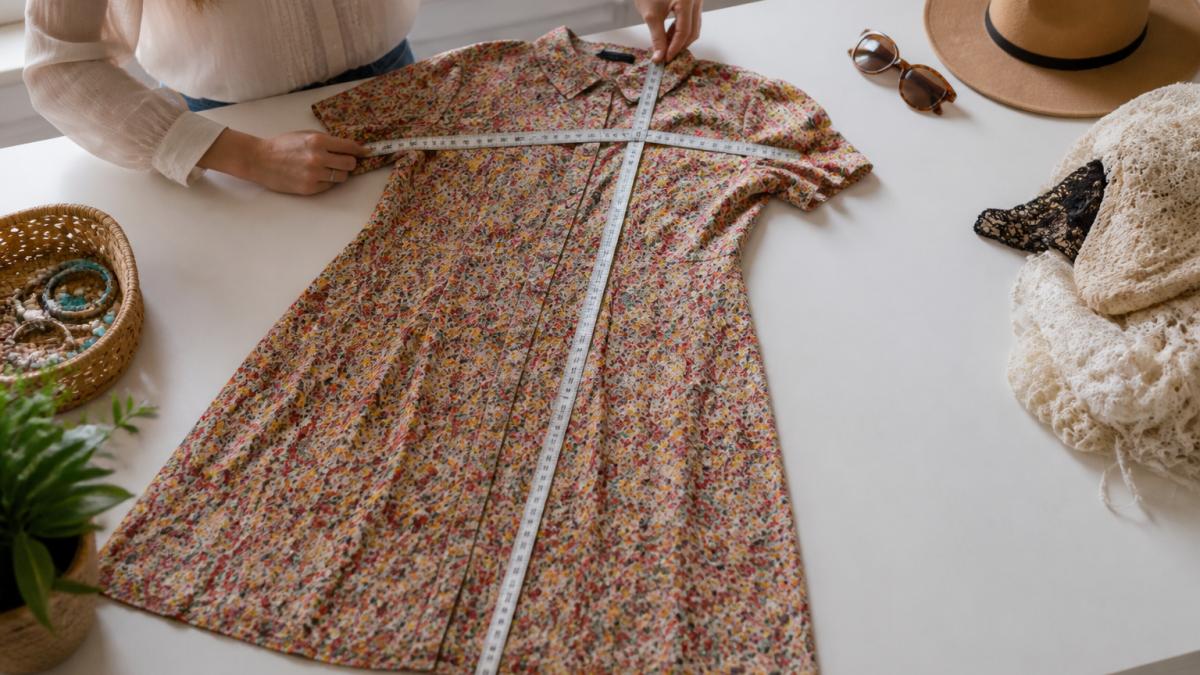
Always measure garments when they're laid flat on a clean surface. Hanging measurements can stretch the fabric and give false readings.
Bust: Lay the garment flat. Measure from armpit to armpit across the front, then double that number. This gives you the full bust circumference. Vintage clothing often has more seam allowance, so check where the seams actually sit.
Waist: Measure at the narrowest point of the garment, usually where the waistband sits or where the fabric naturally tapers. Again, measure one side and double it.
Length: Measure from the top of the shoulder seam straight down to the hem. For dresses, this is your key measurement for whether the length will work for your frame.
Sleeve length: Measure from the shoulder seam to the cuff or edge of the sleeve.
Hip: If the garment has a defined hip, measure at that point.
The key is consistency. Always measure the same way so you can compare across multiple pieces.
Vintage vs. Modern Clothing Sizes
Here's where the numbers get real. A vintage dress labeled size 8 is typically cut for a 28-30 inch waist. A modern size 8 is cut for a 30-32 inch waist. That's a meaningful difference.

| Measurement | Vintage 1950s | Modern 2026 | Difference |
|---|---|---|---|
| Size 8 Bust | 34-35" | 36-37" | 2-3" larger |
| Size 8 Waist | 26-28" | 28-30" | 2-3" larger |
| Size 10 Bust | 36-37" | 38-39" | 2-3" larger |
| Size 10 Waist | 28-30" | 30-32" | 2-3" larger |
These aren't small differences. They affect how a garment drapes and whether it fits at all.
Vintage 1970s and 1980s sizing falls somewhere in between. A 1980s size 10 is larger than a 1950s size 10 but smaller than a modern size 10. The transition happened gradually as vanity sizing crept into the market.
Painted Floral Vintage Dress →
The real takeaway: your vintage size and your modern size are probably different. If you wear a modern size 6, you might fit a vintage size 10 or 12. If you wear a modern size 12, you might fit a vintage size 14 or 16. This is why measuring is non-negotiable.
Using a Vintage Clothing Size Chart
A vintage clothing size chart is a reference tool, not a guarantee. Use it to narrow your search, then verify with measurements.
When you're shopping online for vintage pieces, look for sellers who provide actual measurements in inches. A seller who lists "bust: 36 inches, waist: 28 inches, length: 38 inches" is giving you usable information. A seller who only lists "size 8" is not.
Compare those measurements to your own. If your bust is 36 inches and the garment's bust is 36 inches, you have a potential fit. If your waist is 30 inches and the garment's waist is 28 inches, the garment will be tight.
Remember that vintage clothing often has less stretch than modern clothing. A tight fit on a modern garment might still work because the fabric gives. A tight fit on a vintage piece made from rigid cotton or wool will not stretch to accommodate you.
Some vintage sellers provide era-specific size charts (1950s sizing, 1970s sizing, etc.). These are helpful guides but still imperfect. Individual manufacturers within the same era varied their cuts. Use the chart as a starting point, then rely on the actual garment measurements.
How to Shop for Vintage Clothing Online
Shopping for vintage online requires a different approach than buying modern clothing. You can't try things on, returns can be complicated, and the piece you're buying is one-of-a-kind.
Request measurements before buying. Ask the seller for specific measurements in inches. Don't accept vague descriptions like "runs small" or "true to size." Get numbers.
Ask about fabric content. Natural fibers like cotton and wool behave differently than synthetics. Vintage wool can shrink if washed incorrectly. Vintage silk can be delicate.
Check the condition carefully. Look at all the photos the seller provides. Check for stains, holes, loose seams, or fading. Vintage clothing has lived a life. Minor wear is normal. Major damage affects both fit and durability.
Understand the return policy. Some vintage sellers don't accept returns. Others accept returns within 14 days if the item is unworn. A few offer full returns. Know the policy before you buy.
Compare to garments you already own. If you have a dress that fits you perfectly, measure it. Then compare those measurements to the vintage piece you're considering. This is your most reliable method.
Order from sellers with good reviews. Vintage sellers who provide accurate measurements and honest descriptions build reputations. Check reviews specifically for fit accuracy. If multiple reviewers say a piece ran small or large, believe them.
Our curated vintage-inspired pieces come with detailed measurements and fit information so you know exactly what you're getting. Our Painted Floral Vintage Dress and Wildflower Vintage Dress, for example, are both true to size with full size charts provided.

Common Mistakes When Buying Vintage
New vintage shoppers make predictable mistakes. Knowing them helps you avoid costly purchases.
Mistake 1: Trusting the size tag. The biggest error is assuming the size label tells you anything reliable. It doesn't. Measure the garment. Period.
Mistake 2: Buying based on photos alone. Photos can be misleading. Lighting, angles, and styling create illusions. A dress might look fitted in a photo but actually have significant ease.
Mistake 3: Ignoring fit ease. Vintage garments, especially from the 1950s and earlier, were designed with generous ease. This isn't a flaw, it's intentional.
Mistake 4: Overlooking fabric behavior. A vintage silk slip will behave completely differently than a modern polyester slip. Vintage wool can shrink. Vintage cotton can fade.
Mistake 5: Buying without knowing the return policy. Vintage is final sale at many sellers. If the fit is wrong, you're stuck. Always know the policy before purchasing.
Mistake 6: Not accounting for alterations. Vintage tailoring is often possible but costs money. A dress that's 2 inches too long can be hemmed.
Finding vintage clothing that fits well is absolutely possible. The process just requires patience and a willingness to measure.
When you're ready to explore vintage-inspired pieces with confidence, shop JazzySuSu's curated collection.
Frequently Asked Questions
Does vintage clothing run smaller than modern clothing?
Yes, vintage clothing typically runs smaller. Sizing standards have shifted over decades, a vintage size 8 often fits like a modern size 4 or 6. Body measurements, not size labels, are your best guide. Always measure the actual garment and compare those measurements to your own body measurements before purchasing. This is especially true for vintage pieces from the 1950s and 1960s, which were cut for different body proportions than contemporary clothing.
How do I find my size in vintage clothing?
Measure your bust, waist, hip, and shoulder width in inches, then compare those measurements to the garment's laid-flat measurements. Don't rely on the size tag. Check the seller's size chart if available, but verify it against actual measurements listed in the product description. For online shopping, ask the seller for specific dimensions if they're not provided. Consider fit ease and garment construction, vintage pieces often have less stretch and different silhouettes than modern clothing.
Should I size up when buying vintage clothing?
Not automatically. Sizing up without measuring is a common mistake that leads to poor fits. Instead, measure the specific garment and compare those measurements to your body. Some vintage pieces run small and need sizing up; others fit true to their era's standards. The key is using actual measurements rather than guessing based on size labels. If measurements show the garment is close but slightly tight, sizing up one size may work, but confirm with the seller first.
What should I do if vintage clothing doesn't fit when it arrives?
Check the seller's return policy before purchasing. Many vintage retailers offer returns within 14-30 days if the item hasn't been worn. Keep tags attached and store the garment carefully during the return window. If alterations are needed, factor in tailoring costs, a professional alteration can run $30-$100 depending on the work required. For significant fit issues, returning is usually more cost-effective than altering. Always photograph the garment upon arrival to document its condition for return claims if necessary.