
Tulle and Batiste vs Independent Boutiques: 2026 Guide
Table of Contents
- Tulle and Batiste vs Independent Boutiques: The 2026 Comparison Table
- Business Models Compared: In-House Label vs Curated Boutique
- The Benefits of Shopping at Independent Boutiques
- Cost-Per-Wear: What Tulle and Batiste and Boutique Pieces Really Cost
- Bohemian Capsule Wardrobe Essentials From Both Models
- How to Style Vintage-Inspired Fashion for Everyday and Occasion Wear
- Which Model Fits Your Wardrobe: A Decision Framework
- Frequently Asked Questions
Last Updated: September 14, 2026
Tulle and Batiste vs Independent Boutiques: The 2026 Comparison Table
Choosing between a single-label atelier and a multi-brand boutique comes down to one question: do you want depth in one aesthetic, or range across many? Tulle and Batiste vs independent boutiques is really a comparison of two business models, and each one serves a different kind of shopper. At JazzySuSu, we curate vintage-inspired fashion, handpicked jewelry, and home decor for free-spirited individuals, so we spend a lot of time thinking about how curation works. This guide breaks down the trade-offs honestly, including the ones most brand blogs skip.

Here's the short version: a single-label house like Tulle and Batiste gives you a consistent design language and deep sizing within one look. A curated boutique gives you breadth, dresses, jewelry, decor, but the quality varies piece by piece unless the curation is disciplined.
| Factor | Tulle and Batiste | Independent Boutiques |
|---|---|---|
| Business model | In-house label, direct-to-consumer | Multi-brand curation |
| Product range | Focused, one aesthetic | Broad, multiple categories |
| Sizing approach | Standardized across styles | Varies by maker |
| Best for | Loyalty to one look | Wardrobe building across needs |
| Main risk | Limited variety | Inconsistent quality |
Business Models Compared: In-House Label vs Curated Boutique
An in-house label designs, produces, and sells its own garments, which means one design team controls fit, fabric, and finishing across every drop. A curated boutique buys from many small makers and independent labels, then edits that assortment down to what fits its customer.
That distinction shapes everything downstream, and the mechanism is worth spelling out because it explains most of the friction shoppers run into.
How an in-house label operates. One team owns the pattern block, the size chart, and the fabric buy. Because the same block is graded across a range, a medium in one dress fits like a medium in the next. Production runs are planned a season or more ahead, so the label can commit to a fabric mill and negotiate a lower per-yard cost. The trade-off is rigidity: if a silhouette underperforms, the label still has to sell through it, and if a silhouette sells out, restocking depends on whether the mill still has that fabric.
How a curated boutique operates. A boutique buys finished goods from many small makers, often at wholesale, then marks them up to cover overhead. Because each maker cuts to its own block, the boutique cannot promise a unified size chart. What it can do is edit: a disciplined buyer rejects most of what they see and stocks only pieces that fit the store's point of view. The trade-off is that the boutique's quality ceiling and floor are set by whichever makers it chose that season, not by a single standard it controls.
Here is the part most guides skip: the two models carry different risk, and that risk gets priced into what you pay.
| Dimension | In-House Label | Curated Boutique |
|---|---|---|
| Who owns the size chart | The label, across all styles | Each maker, individually |
| Production planning | Seasons ahead, larger runs | Small runs, often reordered |
| Fabric sourcing | Direct from mill, negotiated | Via the maker's own supply |
| Restock likelihood | Depends on fabric availability | Depends on the maker's capacity |
| Quality consistency | Controlled by one team | Set by the buyer's edit |
| Where your money goes | Design, production, marketing | Wholesale cost plus curation |
Neither model is inherently more ethical or more sustainable. Both can be done well, and both can be done badly. A single label can run a transparent, small-run operation; a boutique can stock mass-produced goods under a handmade label. The real signal is transparency: does the seller tell you who made the piece and where the fabric came from? That question cuts across both models.
What the model does tell you is what to expect about fit consistency and restock behavior. If you find a label whose block fits you, staying inside that label removes a variable. If you need range across categories, a boutique removes a different variable, the time cost of sourcing from five places.
The Benefits of Shopping at Independent Boutiques
Independent boutiques give you range that no single label can match, and they often surface small makers you'd never find otherwise. A good boutique acts as a filter, saving you from scrolling through hundreds of near-identical listings.
There's a real economic argument here too. Boutiques typically buy in small quantities, so a piece that sells out is genuinely gone. That scarcity is a feature, not a marketing trick.
Curation and the Small-Batch Advantage
Small-batch production means fewer units per style, which reduces the odds of seeing your dress on three other people at the same event. It also means restocks are slow or nonexistent, so if you love something, waiting rarely pays off.
The trade-off: small batches can't absorb returns as easily, so exchange policies tend to be tighter than at large retailers. Read them before you buy, not after.
How to Verify Ethical Claims Before You Buy
Verification is where most shoppers give up, and it's where the bad actors win. A "sustainable" badge means nothing on its own. What matters is whether the claim is specific enough to be checked.
Use this checklist before you commit:
- Does the product page name the fabric content, not just "premium materials"?
- Is there a named maker, workshop, or country of production?
- Does the brand explain what "small-batch" means in units?
- Are care instructions included, since garment longevity starts there?
- Does the return policy exist and is it readable in under a minute?
- Can you find the same piece listed on a mass marketplace under a different name?
That last item is the fastest test. If a "handmade" piece appears identically on a bulk marketplace, the curation claim is marketing, not reality.
Cost-Per-Wear: What Tulle and Batiste and Boutique Pieces Really Cost
Cost-per-wear is the price of a garment divided by the number of times you actually wear it. A $241.99 dress worn forty times costs about $6 per wear (Hacked Email: What to Do). A $40 fast-fashion dress worn twice costs $20 per wear. The cheaper garment is the expensive one.
That is the headline math, but it hides the variables that decide whether the math holds. Cost-per-wear is only useful if you are honest about the inputs: how many wears a fabric realistically survives, what care costs, whether the piece can be repaired, and whether it holds any resale value.
The four variables that move the number.
- Fabric durability. Tulle and batiste behave differently. Tulle is a stiff, open-weave netting that holds shape but snags easily; batiste is a lightweight, semi-sheer plain weave that drapes well but can pill or tear at stress points. A tulle dress worn to a garden event may pick up snags that shorten its life, while a batiste blouse may soften and last for years if washed gently. The fabric, not the price tag, sets the ceiling on wears.
- Care cost. Dry cleaning a structured tulle gown can run $15 to $30 per cleaning in most markets (the FTC). If you clean it after every wear, that cost belongs in your math. A hand-washable batiste piece has a near-zero care cost, which lowers its effective cost-per-wear even at the same purchase price.
- Repairability. A seam that can be re-stitched, a hem that can be let down, or a bead that can be reattached extends a garment's life. Pieces with simple construction and accessible seams are cheaper to keep alive than heavily structured pieces with fused layers.
- Resale value. Some slow-fashion pieces hold a meaningful fraction of their price on resale marketplaces; most fast-fashion pieces hold almost none. If you can resell a $241.99 dress for $80 after forty wears, your true cost is closer to $4 per wear.
Here is how the math looks once care and resale are folded in:
| Purchase | Price | Wears | Care cost | Resale | Effective cost per wear |
|---|---|---|---|---|---|
| Fast-fashion dress | $40 | 2 | $0 | $0 | $20.00 |
| Fast-fashion dress | $40 | 5 | $10 | $0 | $10.00 |
| Slow-fashion dress | $100.99 | 20 | $0 | $0 | $5.05 |
| Slow-fashion dress | $100.99 | 40 | $0 | $0 | $2.52 |
| Slow-fashion dress | $241.99 | 40 | $60 | $80 | $5.55 |
The Tulle Bow Tulle Dress at $100.99 is a good illustration: a romantic, woven spring-summer piece that works for weddings, showers, and dinners, which is exactly the kind of item that earns repeat wears. It is also hand-washable, which keeps care cost near zero and protects the cost-per-wear figure.
The [FTC guidance on environmental marketing claims | ftc.gov] is worth reading, because it explains why "sustainable" and "eco-friendly" claims need substantiation (the FTC). The same skepticism applies to durability claims. A brand that says a piece will last for years should be able to explain the fabric, the construction, and the care that makes that true.
The counterargument worth taking seriously. Cost-per-wear can be gamed. A $300 dress worn once is a $300-per-wear garment, no matter how ethically it was made. Slow fashion is not automatically good value; it is good value only when the piece actually stays in rotation. The honest test is not "is this expensive?" but "will I wear this enough times to justify it?" If the answer is no, the ethical choice is to not buy it, regardless of who made it.
Bohemian Capsule Wardrobe Essentials From Both Models
A bohemian capsule wardrobe is a small set of versatile, free-spirited pieces that mix into many outfits, built around neutral layers, one or two statement dresses, and jewelry that ties it together. The goal is fewer items, more combinations.
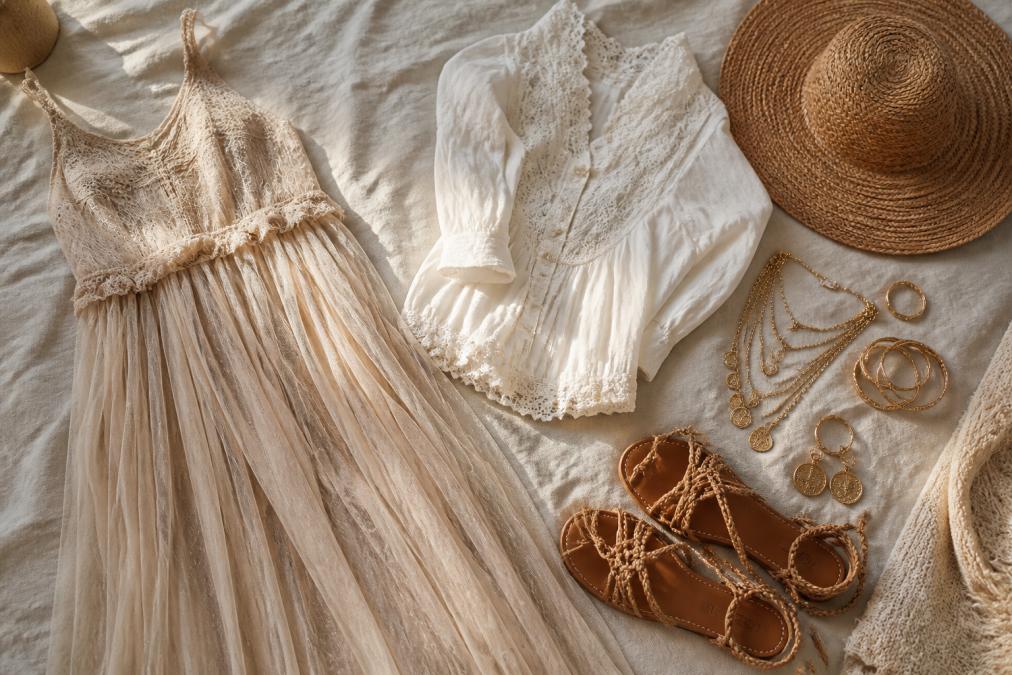
Whether you buy from a single label or a boutique, the essentials list barely changes:
- One tulle or lace midi dress that works for both daytime and evening
- One structured statement dress for occasions
- Two layering tops in neutral tones
- One piece of handpicked jewelry that anchors the look
- Sandals and a hat for effortless chic
The difference is sourcing. A single label gives you the dress and maybe the top. A boutique can fill the jewelry and accessories slots from independent makers, which is how a capsule actually gets completed.
How to Style Vintage-Inspired Fashion for Everyday and Occasion Wear
Vintage-inspired fashion works best when you modernize one element and keep the rest restrained. The mistake is styling every piece as a period costume, which reads as costume rather than personal style.
For daytime, pair a tulle midi with flat sandals and a simple knit. For evening, swap to heels and add the jewelry. The same dress covers both, which is the whole point of buying well.
For bridal and occasion wear, custom tailoring changes the equation. A made-to-measure piece like the Handmade-to-Order Strapless Bustier Bridal Dress at $399.00 is cut to your measurements, so the fit problem that ruins most vintage silhouettes disappears. The Custom Lace & Tulle Beaded A-Line Gown at $133.20 takes the same approach with hand-placed lace appliques and beadwork on off-white tulle.

If you want volume without full length, the Tube Ruffle Cupcake Dress at $241.99 brings tiered tulle ruffles and a strapless bodice to bridal showers and birthdays.

Which Model Fits Your Wardrobe: A Decision Framework
Pick the single-label route if you've found an aesthetic you trust and want fit consistency above variety. Pick a curated boutique if you're building a wardrobe across categories and want one place to source dresses, jewelry, and accents together.
Run it as a quick test:
| If you... | Choose |
|---|---|
| Wear one signature look repeatedly | Single-label house |
| Need dresses, jewelry, and decor in one order | Curated boutique |
| Are between standard sizes | Made-to-measure from either |
| Want to verify sourcing before buying | Whichever publishes specifics |
| Shop for both festivals and everyday | Curated boutique |
For most readers, the boutique model wins on range and the single-label model wins on consistency. JazzySuSu sits in the boutique camp, with pieces selected to be worn repeatedly rather than replaced each season.
Frequently Asked Questions
How do independent boutiques differ from niche online brands like Tulle and Batiste?
A niche label like Tulle and Batiste designs and produces its own line, so every piece reflects one house aesthetic and one production process. An independent boutique curates from many small makers, which means more variety in silhouettes, fabrics, and price points in one place. The trade-off: a single label gives you consistency and a defined fit, while a boutique gives you range and the ability to mix artisan-made pieces from different sources. Neither model is automatically more ethical; what matters is whether the seller publishes where the fabric comes from and who made the garment.
What should you look for when shopping for ethical boho clothing?
Start with three checks. First, does the product page name the fabric and its origin, or just say 'premium blend'? Second, is there a size chart with real measurements and a stated fit note, since garment longevity depends on getting the fit right? Third, can you find a returns policy in plain language?
How can you build a capsule wardrobe using bohemian pieces?
Pick a base palette of two neutrals and one accent, then choose pieces that cross occasions. A tulle midi in off-white works for a bridal shower, a dinner, and a styled workday with a blazer. Add a lace-trimmed top, one printed maxi, and one structured layer. Cap the capsule at 10 to 12 items and check that each new purchase pairs with at least three things you already own. Bohemian capsule wardrobe essentials are less about a specific list and more about whether every piece earns repeat wear.
Is Tulle and Batiste a sustainable fashion brand?
Tulle and Batiste positions itself around slow fashion and small-batch production, but the label's own marketing is not independent verification. To judge any brand's sustainability claims, look for specifics: named mills, fiber content, certifications, and whether the brand publishes a supplier list. Vague language about being eco-conscious is common across the industry and does not by itself confirm ethical manufacturing. If a brand cannot tell you where a fabric was woven, treat the claim as aspirational rather than proven.
What are the benefits of supporting independent fashion retailers?
Independent boutiques typically buy in small quantities, so they carry pieces you will not see on everyone at the same event. They also tend to stock artisan-made and handcrafted goods from smaller producers, which keeps money with makers rather than layers of distribution. The practical benefit is curation: someone with taste has already filtered hundreds of options down to a short list you can actually browse.
The hardest part of building a wardrobe you actually keep isn't finding beautiful pieces, it's finding a source you can trust to tell you what you're buying. JazzySuSu curates vintage-inspired fashion, handpicked jewelry, and lifestyle finds with pieces designed to be worn again and again, and offers free shipping on orders over $100. Start with one anchor piece and build from there. Shop now at JazzySuSu and find the pieces that earn their cost per wear.