
Vintage vs Modern Fashion for Everyday Wear: 2026 Guide
Table of Contents
- Vintage vs Modern Fashion: A Quick Comparison
- The Benefits of Vintage-Inspired Fashion for Daily Wear
- How to Style Vintage Clothing Without Looking Costume-y
- Mixing Vintage and Modern Outfits: A Step-by-Step Formula
- Cost Per Wear: Vintage vs Modern for Everyday Wear
- Care and Maintenance: Which Lasts Longer?
- Capsule Wardrobe Integration: Building a Curated Closet
- Frequently Asked Questions
Last Updated: September 19, 2026
Vintage vs Modern Fashion: A Quick Comparison
Vintage vs modern fashion for everyday wear comes down to a simple trade-off: modern pieces win on convenience and stretch, while vintage-inspired pieces win on construction, longevity, and character. The best everyday wardrobes borrow from both. This guide from JazzySuSu breaks down durability, cost per wear, fit, and styling so you can build a closet that actually gets worn.
Vintage-inspired fashion is clothing designed with retro silhouettes, prints, and construction details from past decades, made with modern sizing and materials. Modern fashion refers to current-season mass-produced garments built around trend cycles and low price points.
Here's the part most guides skip: the real difference isn't old versus new.
| Factor | Vintage-Inspired | Modern Fast Fashion |
|---|---|---|
| Fabric | Natural fibers, cotton blends | Synthetic blends, thin knits |
| Construction | Seam allowance, lined bodices | Minimal finishing, raw edges |
| Fit | Structured, tailored silhouette | Relaxed, trend-driven cuts |
| Lifespan | Years with proper care | One to two seasons |
| Cost per wear | Low over time | Low upfront, high over time |
The Benefits of Vintage-Inspired Fashion for Daily Wear
The strongest case for vintage-inspired fashion is practicality, not nostalgia. Heavier cotton, defined tailoring, and timeless silhouettes mean these pieces survive washing, wearing, and trend cycles. A 1950s-style dress with a full skirt and hidden pockets works for a Tuesday meeting and a Saturday market.
Other everyday benefits:
- Individuality without effort. Fewer people own the same piece.
- Sustainability by default. Wearing a garment longer is the most effective way to reduce fashion waste, a point echoed by the EPA's textile waste data.
- Layering flexibility. Structured pieces layer under modern jackets and over simple tees.
- Fit and flare silhouettes flatter a wider range of body types than trend-cut tops.
How to Style Vintage Clothing Without Looking Costume-y
The key to styling vintage clothing is anchoring it with at least one modern piece. A full retro look reads as a costume. A single vintage statement piece paired with contemporary basics reads as personal style.
The three most common mistakes:
- Wearing head-to-toe vintage. Every era at once looks theatrical.
- Ignoring the silhouette. If the skirt is full, keep the top fitted.
- Over-accessorizing. One vintage detail per outfit is enough.
Modern Anchors: The 3-Item Rule
For every vintage piece, add three modern items: modern shoes, a modern bag, and a modern top or jacket. This rule keeps the outfit grounded. A vintage floral dress with plain white sneakers, a structured leather tote, and a denim jacket looks intentional. The same dress with T-strap heels, a beaded clutch, and a feather headband looks like a theme party.
Mixing Vintage and Modern Outfits: A Step-by-Step Formula
Mixing vintage and modern outfits works best with a repeatable formula. Use this five-step process for any outfit.
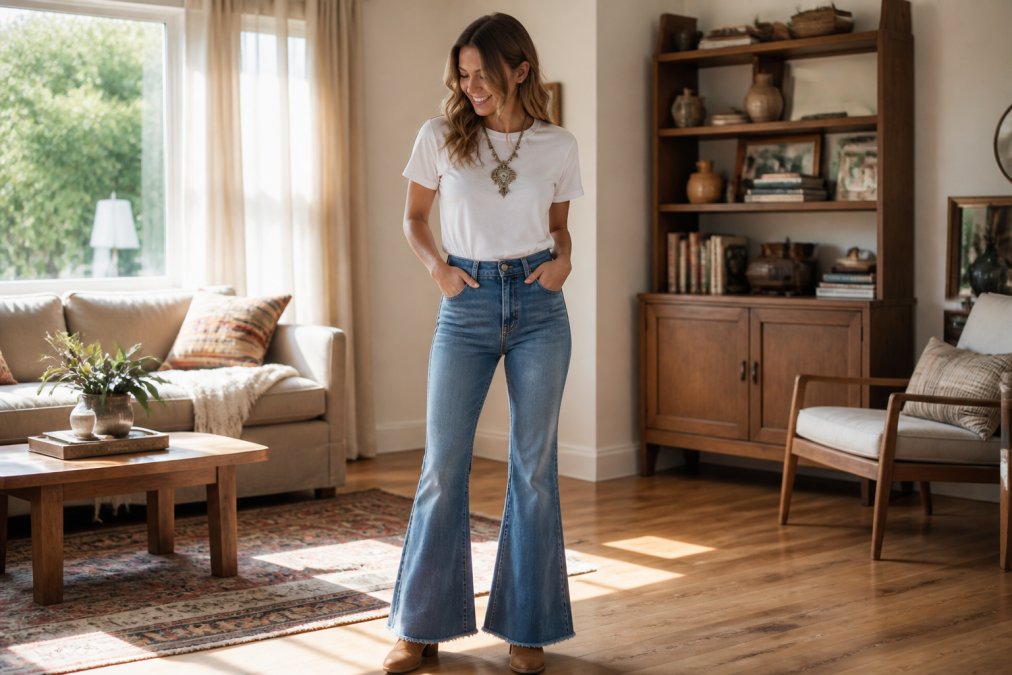
- Pick one vintage anchor. Jeans, a dress, or a skirt, but only one.
- Choose modern basics for the rest. Plain tees, simple knits, clean sneakers.
- Match the silhouette. Fitted top with full bottom, or the reverse.
- Add one vintage accessory. A single piece of handpicked jewelry is enough.
- Check the mirror at arm's length. If it looks like a costume, remove one vintage item.
Cost Per Wear: Vintage vs Modern for Everyday Wear
Cost per wear is the real test of value. A $20 fast-fashion top worn twice costs $10 per wear. A $68.99 pair of jeans worn 100 times costs about $0.69 per wear. The cheaper garment loses.
The Math: $68.99 Jeans vs. $20 Fast Fashion
| Metric | $68.99 Vintage-Inspired Jeans | $20 Fast Fashion Jeans |
|---|---|---|
| Upfront cost | $68.99 | $20.00 |
| Realistic wears | 100+ | 10-15 |
| Cost per wear | Under $0.70 | $1.33-$2.00 |
| Replacement frequency | Rarely | Every season |
The FTC's guidance on textile labeling requires accurate fiber content disclosure, which helps you compare what you're actually buying before you spend.
RetroCurve™ – Vintage Flare Bootcut →
Care and Maintenance: Which Lasts Longer?
How each fabric type actually breaks down:
- Cotton and linen (common in vintage-inspired pieces): Fibers are short-staple and abrasion-resistant. They handle repeated washing but shrink 3-5% on a hot dry cycle and fade under UV. Cold wash + line dry preserves both fit and color.
- Wool and structured tailoring: Fibers have natural crimp that resists wrinkling, but heat and agitation cause felting, the fibers lock together and the garment permanently shrinks. Hand wash or dry clean, and never tumble dry.
- Rayon and viscose (common in mid-century reproductions): Weak when wet. A machine wash can stretch a rayon dress two sizes. Hand wash cold, roll in a towel to remove water, dry flat.
- Polyester and synthetic blends (common in fast fashion): Strong when wet, but pills at friction points (underarms, hip, thigh) within 10-20 washes. Pilling is permanent, no wash routine reverses it.
- Beaded, sequined, or embroidered pieces: Thread and adhesive degrade with heat and agitation. Hand wash in cold water with a drop of mild detergent, or spot clean. Machine washing is the single fastest way to destroy embellishment.
A practical routine that works for both:
- Sort by fiber, not by color, when in doubt. Natural fibers and synthetics have different tolerances.
- Wash cold (below 86°F) on a gentle or hand-wash cycle. Heat is the enemy of every fiber except polyester.
- Turn structured pieces inside out and use mesh bags for anything with buttons, hooks, or trim.
- Air dry flat or on a line. A dryer is the leading cause of shrinkage, pilling, and elastic failure.
- Store structured pieces on padded hangers; fold knits to prevent shoulder stretch.
The lifespan math: A cotton dress washed cold and air-dried can hold its shape for 5-10 years of regular wear. The same dress washed hot and tumble-dried may show fading, shrinkage, and seam stress within 18 months. Fast-fashion synthetics typically show visible pilling within 3-6 months of weekly wear regardless of care, because the fiber itself degrades at friction points.
Capsule Wardrobe Integration: Building a Curated Closet
The 10-piece framework (blending both eras):
| Slot | Piece | Era | Why it earns its place |
|---|---|---|---|
| 1 | High-waisted flare or straight jeans | Vintage-inspired | Anchors 4+ outfits; pairs with every top |
| 2 | Mid-century cotton day dress with pockets | Vintage-inspired | One-piece outfit; layers under jackets |
| 3 | Structured vintage-print dress | Vintage-inspired | Covers occasions without a separate wardrobe |
| 4 | Plain white or cream tee | Modern | The universal base layer |
| 5 | Neutral knit (crew or turtleneck) | Modern | Bridges seasons; layers over dresses |
| 6 | Denim or utility jacket | Modern | The modern anchor that de-costumes vintage |
| 7 | Tailored blazer or cardigan | Modern | Adds structure to soft vintage silhouettes |
| 8 | Clean sneakers or loafers | Modern | Grounds full-skirt silhouettes |
| 9 | Structured leather tote | Modern | Reads intentional, not themed |
| 10 | One signature vintage accessory | Vintage-inspired | The personality piece |
Seasonal rotation: A true capsule doesn't swap out entirely by season. Instead, rotate 2-3 pieces, a heavier knit in, a lighter tee out, and keep the anchors (jeans, day dress, jacket, tote) year-round. This is where vintage-inspired pieces outperform trend-driven modern ones: a well-made cotton dress works in April and October with only a layer change.

Frequently Asked Questions
How do I mix vintage pieces with modern clothing for a balanced look?
Start with a modern base like plain jeans or a simple tee, then add one vintage-inspired piece such as a floral dress or a statement jacket. Keep the rest of your outfit minimal. For example, pair the Painted Floral Vintage Dress with modern white sneakers and a denim jacket. This anchors the retro element so it reads as intentional style, not a costume.
What are the benefits of choosing vintage-inspired fashion over fast fashion?
Vintage-inspired pieces often use higher-quality materials and construction, so they last longer and cost less per wear. They also offer unique silhouettes and prints you won't see everywhere. Choosing vintage-inspired fashion supports a more sustainable wardrobe by reducing demand for disposable trends. Many pieces, like the 1920s Flapper Dress, are hand-embellished and designed to be worn for years.
Is vintage clothing more durable than modern mass-produced apparel?
It depends on the garment. Well-made vintage-inspired pieces from brands like JazzySuSu use durable fabrics like 100% cotton and reinforced stitching. Fast fashion often uses thin synthetic blends that pill or tear quickly. Check for details like seam allowance, lining, and natural fibers. A high-quality vintage reproduction can outlast several fast-fashion equivalents.
How can I tell if a vintage garment is suitable for everyday wear?
Look for comfort and practicality. Check if the fabric breathes (cotton and linen are good), if the fit allows movement, and if the care instructions are manageable. Pieces like the RetroCurve Vintage Flare Bootcut Jeans have stretch and a high-rise fit that works for daily activities. Avoid delicate beading or dry-clean-only fabrics for regular rotation.
How do I care for vintage-inspired pieces to ensure they last?
Always follow the care label. For cotton dresses like the Wildflower Vintage Dress, machine wash cold and hang dry. For beaded items like the 1920s Flapper Dress, hand wash inside out and lay flat to dry. Store hanging to prevent wrinkles and preserve embellishments. Proper care keeps colors vibrant and extends the life of your wardrobe staples.