
7 Ways to Start a Retro Inspired Wardrobe
Table of Contents
- 1. Define Your Retro Era Before You Buy a Single Piece
- 2. Learn How to Mix Vintage and Modern Style Without Looking Costumey
- 3. Build a Retro Inspired Capsule Wardrobe Essentials List
- 4. Master Styling Vintage Accessories for Beginners
- 5. Get the Fit Right: Sizing Challenges With Retro Cuts
- 6. Source Smart: Thrifting, Second-Hand, and Budget-Friendly Finds
- 7. Care for Your Retro Inspired Wardrobe So It Lasts
- Frequently Asked Questions
Last Updated: September 29, 2026
1. Define Your Retro Era Before You Buy a Single Piece
A retro inspired wardrobe starts with a decision, not a shopping spree. Pick one or two eras to anchor your look: a focused point of view reads as style, while a mix of everything reads as a costume rack.
Pick One or Two Eras to Anchor Your Look
Most people who struggle with retro dressing skipped this step, buying a 50s skirt, a 70s jacket, and a Y2K top in the same month, then wondering why nothing works together.
- 1950s: high necklines, full skirts, defined waists
- 1960s: shift shapes, bold prints, Peter Pan collars
- 1970s: high-waisted flares, earthy tones, relaxed fits
- Y2K: low-rise cuts, plaid, playful accessories
Build a Mood Board That Separates Retro From Costumey
A mood board defines your look before you spend money. Save photos of real street style, not period-accurate film stills: period-accurate means head-to-toe replication, which tips into costumey fast, while retro-inspired means borrowing one or two elements and wearing them with modern pieces.
2. Learn How to Mix Vintage and Modern Style Without Looking Costumey
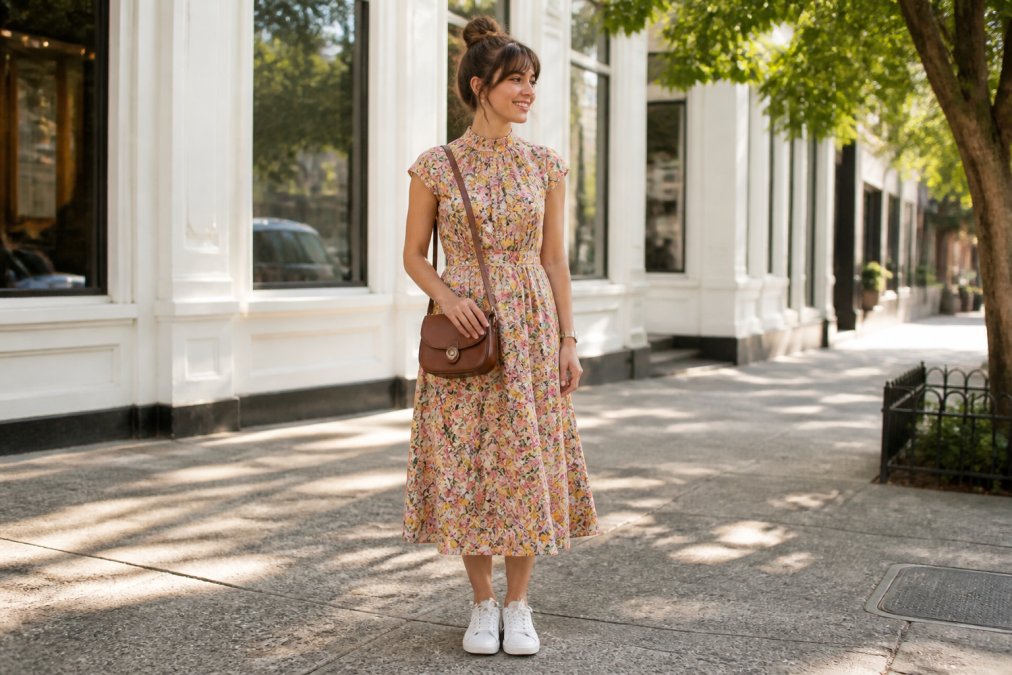
Knowing how to mix vintage and modern style comes down to restraint. Wearing vintage from head to toe looks costumey fastest, so beginners should cap it at one statement piece per outfit.
The One-Vintage-Piece Rule for Beginners
Start with a single retro anchor, a dress, skirt, or high-waisted jeans, and keep everything else modern and neutral.
Pair Retro Silhouettes With Modern Basics
Modern basics are the counterweight. Plain white tees, clean denim, simple leather shoes, and minimal jewelry pull a retro piece into the present.
Try these combinations:
- Full retro skirt with a fitted modern tee
- High-waisted flare jeans with a plain crop top
- Vintage-print dress with modern sneakers and a crossbody bag
- Retro blouse with straight-leg modern denim
3. Build a Retro Inspired Capsule Wardrobe Essentials List
A retro inspired capsule wardrobe essentials list is a small set of versatile pieces that mix in many combinations. Ten well-chosen items can carry an entire season.
The 10 Pieces That Do Most of the Work
| Piece | Why It Earns Its Place | Works With |
|---|---|---|
| One vintage-print dress | Instant outfit, no styling needed | Sneakers, boots, heels |
| High-waisted flare jeans | 70s silhouette, modern comfort | Tees, blouses, knits |
| A-line midi skirt | Flattering on most frames | Fitted tops, cardigans |
| Fitted knit top | Balances full skirts and wide legs | Everything in the list |
| Peter Pan collar blouse | Soft retro detail, easy to layer | Jeans, skirts, under sweaters |
| Vintage-inspired cardigan | Adds era texture without bulk | Dresses, jeans, skirts |
| One statement accessory | Vintage accessories anchor the look | Any plain outfit |
| Neutral modern sneakers | Grounds retro pieces in the present | Dresses, skirts, jeans |
| Leather crossbody bag | Timeless design, modern shape | Every outfit above |
| One great pair of boots | Ties fall and winter looks together | Skirts, jeans, dresses |
4. Master Styling Vintage Accessories for Beginners
Styling vintage accessories for beginners is simple: choose one focal accessory and let the rest of the outfit stay quiet. Accessories are the cheapest way to shift a modern outfit into retro territory.
Start with these:
- A structured handbag with a vintage shape
- A silk scarf tied at the neck or on a bag handle
- Pearl or cameo jewelry for a subtle period nod
- A wide brim hat for warmer months
- Cat-eye or round frames if you wear glasses
5. Get the Fit Right: Sizing Challenges With Retro Cuts
Sizing is the most common reason a retro outfit looks wrong. Vintage and vintage-inspired cuts follow different proportions than modern clothing, so your usual size often does not translate, and a 1960s dress cannot be exchanged in a different size. Fit starts with your own numbers, not the tag.
Why Vintage Sizing Does Not Match Modern Sizing
Ready-to-wear sizing was never standardized across eras. A vintage 1950s size 12 typically corresponds to a modern 6 to 8, because vanity sizing has shifted numeric labels downward over the decades. The same drift applies to men's suiting, where a vintage 40 regular can measure closer to a modern 38.
- 1950s: defined natural waist, fuller bust and hip allowances, longer torso
- 1960s: straighter shift shapes with less waist shaping, shorter hems
- 1970s: lower or high-rise waists depending on year, wider shoulders, flared legs
- Y2K: low-rise waists, narrower hips, shorter inseams
Measure Yourself Before You Measure the Garment
Before you shop, take four measurements with a soft tape measure over light clothing:
- Bust or chest, around the fullest point, tape level
- Natural waist, the narrowest point, usually just above the navel
- Hips, around the fullest point, roughly 8 inches below the waist
- Inseam, from crotch seam to desired hem on a pair of pants that fit you
A Practical Fit Checklist for Retro Cuts
- Compare your measurements to the garment's, not to the size on the label
- Allow 1 to 2 inches of ease on structured pieces like blazers and fitted bodices
- Size up if you are between sizes on non-stretch vintage, tailoring down is easier than letting out
- Check shoulder seams first; if they sit past your natural shoulder, walk away
- Expect to hem longer skirts and sleeves on second-hand finds
- For high-waisted pieces, confirm the rise hits your natural waist, not your hips
What Is Worth Tailoring, and What Is Not
A good tailor can take in a waist, shorten a hem, taper a sleeve, or add darts, routine, inexpensive alterations. What a tailor cannot easily fix is shoulder width, armhole depth, or a too-short bodice, which require rebuilding the garment. Experienced vintage shoppers buy for the shoulders and bust, then tailor everything below: if the shoulders fit and the fabric is sound, the rest is usually adjustable.
Painted Floral Vintage Dress →
6. Source Smart: Thrifting, Second-Hand, and Budget-Friendly Finds
Thrifting and second-hand shopping stretch a retro wardrobe budget further than buying new, but generic advice only gets you so far. The real edge is knowing which channels to work, in what order, and how to search them like a buyer rather than a browser.
Rank Your Sourcing Channels by Cost and Yield
Not every channel is worth your time at every budget. A practical order:
- Local thrift and charity shops, lowest cost, highest variance. Best for basics, denim, and knitwear.
- Estate sales, mid cost, highest quality ceiling. Older homes often hold well-made garments from the 1950s through the 1980s that were worn lightly and stored properly.
- Consignment and vintage boutiques, higher cost, curated and already vetted. Worth it when you need one specific era piece and do not want to hunt.
- Online resale marketplaces, broadest selection, variable pricing. Best when you know your measurements and can ask sellers for flat-lay photos.
- Online vintage specialists, highest cost, highest confidence. Use when fit and authenticity matter more than price.
Search Like a Buyer, Not a Browser
Online resale rewards specific search terms. Try these instead of generic queries:
- Search by era plus garment: "1970s high-waisted flare jeans," not "vintage jeans"
- Search by construction detail: "Peter Pan collar blouse," "A-line midi skirt," "bishop sleeve"
- Search by fabric: "100% cotton 1950s dress," "linen 1970s skirt"
- Search by label: many mid-century American and European labels are searchable by name and carry known size and quality reputations
- Use saved searches with notifications so new listings reach you instead of you refreshing the app
How to Spot Quality Construction and Natural Fibers
Quality craftsmanship shows up in small details. Check the inside of the garment first.
- Seams: look for clean, even stitching with no loose threads; French seams and bound seams signal better construction
- Buttons: check that they are securely attached and match; metal or shell buttons usually outlast plastic
- Zippers: metal zippers usually outlast plastic ones; a brand-name zipper is a good sign
- Lining: a full lining signals better construction, especially on skirts and jackets
- Fabric content: natural fibers like cotton, linen, wool, and silk breathe and age well; check the fiber tag, not the feel alone
A Quick Fiber Identification Guide
When there is no tag, or the tag is faded, these cues help:
- Cotton: matte, slightly rough, wrinkles easily, burns to ash with a paper smell
- Linen: crisp, visible weave, creases sharply, cool to the touch
- Wool: springy, holds a crease, smells like hair when burned
- Silk: smooth, lustrous, lightweight, smells like burnt hair when burned
- Polyester and nylon: slick, holds shape, melts rather than burns, pills over time
Source basics locally, anchor pieces online, and always check the fiber tag before the price tag. A well-made natural-fiber piece at a slightly higher price usually costs less per wear than three synthetic bargains that pill after a season.
7. Care for Your Retro Inspired Wardrobe So It Lasts
Care separates a retro wardrobe that lasts years from one that lasts a season. Vintage and vintage-inspired pieces need gentler handling than fast fashion.
- Wash natural fibers in cold water on a delicate cycle
- Turn garments inside out before washing to protect prints
- Air dry instead of machine drying, which shrinks cotton and fades color
- Store knits folded, not hung, to prevent stretching
- Repair small tears and loose buttons early
- Use a fabric shaver on pilling instead of replacing the garment
Frequently Asked Questions
What is the 3-3-3 rule for building a retro inspired wardrobe?
The 3-3-3 rule means choosing three colors, three silhouettes, and three occasions as your wardrobe foundation. For retro style, pick eras like 1950s, 1970s, or Y2K, then limit yourself to three color families, three core shapes (like A-line, high-waisted, and fitted), and three settings (work, weekend, evening). This keeps your retro inspired wardrobe cohesive instead of random.
How do you mix vintage pieces with modern clothing without looking costumey?
Use the one-vintage-piece rule: let a single retro item be the focal point and keep everything else modern. Pair a vintage floral dress with plain white sneakers, or wear high-waisted flare jeans with a simple modern tee. Avoid stacking multiple period-accurate pieces at once, and skip accessories that read as theatrical. The goal is retro-inspired, not a full costume.
What are the essential staples for a retro inspired capsule wardrobe?
Start with a vintage-style dress with a defined waist, high-waisted flare or bootcut jeans, a fitted knit top, a button-down blouse, a midi skirt, and one structured jacket. Add vintage accessories like a silk scarf, cat-eye sunglasses, and a simple brooch. These retro inspired capsule wardrobe essentials mix and match across decades, so you get multiple outfits from a small number of pieces.
How can I find high-quality vintage-inspired fashion that lasts?
Check garment construction first: look for finished seams, sturdy zippers, and natural fibers like cotton, linen, or wool. A 100% cotton dress with a back zipper and hidden pockets, like the Painted Floral Vintage Dress, signals better build quality than thin synthetic fast fashion. Ask about return policies and sizing charts before buying, and favor sellers who show real product photos.
What are some easy retro outfit ideas for beginners?
Try a high-neck floral dress with ballet flats and a cardigan for daytime, or high-waisted flare jeans with a tucked-in knit top and ankle boots for a 70s feel. For evening, an off-shoulder mesh dress with simple gold jewelry works well. Start with one retro piece per outfit and build confidence before layering more vintage elements.
Building a retro inspired wardrobe takes patience, but the payoff is a closet full of pieces you actually wear. JazzySuSu curates vintage-inspired fashion, handpicked jewelry, and lifestyle finds for exactly this kind of wardrobe, with free shipping on orders over $100 and pieces designed to be worn again and again. Start with one anchor piece, build around it, and let your signature look take shape. Shop now at JazzySuSu and find the pieces that make retro feel like you.